Category: St. Mark Mission

Posts that originally appeared on the website of St. Mark the Evangelist Orthodox Mission of Raleigh, North Carolina.

  • Our Missions in North Carolina

    When I meet people from our more established parishes, they are often curious to hear about our missionary endeavors in North Carolina. Coming from parishes that have been in existence for some time, which gather to worship in full-fledged church buildings with chanters and a congregation made up of many mature Orthodox families, mostly of Greek background, with a smattering of converts, they are often surprised to hear about our work here and what life is like on the “frontiers” of Orthodoxy. With the dual aim of providing further information to our brothers and sisters in the other parishes, and increasing interest in missions so that others may become interested in entering this field, I have decided to compose a few words about our life here and experiences.

    The missions in North Carolina were born out of practicality. My wife and I lived in New York when we were doing our Master’s degrees, and it was there that we found St. Markella’s Cathedral and the Old Calendar Orthodox Church. However, upon completion of our studies, we returned to North Carolina to be near our families. At this point, my wife and I had still not joined the Orthodox Church, and our distance from any Old Calendar parish made church life an ecclesiastical desert. We went to New York for the feasts, and finally in August 2006 we were baptized, even though Metropolitan Pavlos had remarked, “you have been Orthodox in your heart for a long time.”

    Returning to North Carolina, we prayed about our church situation, and receiving a blessing from Metropolitan Pavlos, we began to hold Reader’s services. For those not familiar with the idea, a Reader’s service is any service that is done without a priest; the priest’s parts are removed but the majority of the service stays the same. We did Matins (Orthros) this way, and then the service of Typica, which is the Reader’s service equivalent for the Divine Liturgy.

    On a weekly basis, my wife and I were joined by her brother for services, and occasionally friends or guests would accompany us. On one occasion we had ten people with us; but most weeks it was only the three of us. This continued from November 2006 until November 2007. At times it was daunting, but we never wanted to give up, because we knew that patience would pay off.

    In August 2007, we were blessed to move in to a home, and we constructed a fully-functioning chapel there. Bishop Christodoulos came with Fr. Savvas and a priest from Florida and we celebrated the first Divine Liturgy in November 2007. While there was not a huge crowd, it was a reverent service which filled us with hope for the future.

    Over time, with no priest, growth was not occurring, so it was decided to make me a priest so that liturgy could occur each week here. In the meantime, a blessing occurred when a family contacted me from Greenville, North Carolina, a town about 90 miles to the east of Raleigh. They had discovered the Old Calendar Church, and were willing to set up a Church in their town if a priest could be provided. Around the same time, another man in Raleigh found our mission online, and began attending services. He is now a catechumen preparing for baptism.

    I was ordained deacon in April 2008, and priest in June 2008. In June the family in Greenville had a tenant move out of their rental property, and they converted it in to a Church over the next few months. I celebrated the first liturgy on September 8/21. At Vespers were eight individuals; at liturgy six. Two weeks later, we had the second liturgy, with twelve people in attendance. On the third service, many of the same people returned, and we are praying this becomes an established pattern!

    Currently, I serve liturgy three Sundays a month in Raleigh, and one Sunday and two Saturdays a month in Greenville. In Raleigh, I serve in my Chapel. It’s hard to get the word out because there are concerns both on the side of those interested in attending that the service is in a home; and there are concerns on our side to advertise our address to the whole world. So we proceed cautiously, and this accounts for the slower growth in Raleigh. If ten regulars can be found, we can probably start renting a space, which may help growth. As God wills.

    In order to serve in Greenville, I have to take down all the altar vessels such as the chalice, diskos, censor, antimension, bowls, and everything else, and pack it carefully. We then leave early in the morning to arrive in Greenville, which takes about an hour and a half in the car. When we arrive, we begin to set up for the service, usually the Divine Liturgy of Saint John Chrysostom. Our chanter from Raleigh usually accompanies me, and when it’s a Sunday Presbytera comes, too. She tries to make it on Saturdays when possible though, since we all benefit from the additional fellowship.

    When the service is over in Greenville, I have to carefully pack everything back up. I join in a trapeza—a festal meal—with those attending, and then we return to Raleigh. We usually are back by three o’clock. It’s a long day, but it’s work that I love doing.

    Long term, the hope is that candidates will be identified that can also serve as priests. St. Paul traveled from town to town, and ordained responsible local candidates before moving on. It is my hope that the mission in Raleigh can develop to be a regional hub for southern missions, and that Greenville will produce a priestly candidate in the next few years. God will provide for us and guide us in the direction we should go.

    Similar missionary work is occurring in other places. The newest two communities besides ours are Holy Mother of God in Charlottesville, Virginia, and St John (Maximovitch) in Palmer, Massachusetts. There are some other missions and mission stations (potential missions) growing elsewhere as well. For a full list, consult the directory on the diocese’s website.

    This is only the beginning of our efforts, and we encourage everyone to be aware of missions. Even if you live in an established parish, you can help us with your prayers, and by sending us your friends and relatives if they live near us, are moving near us, or visiting the area. Donations of icons or other church items are always welcome. If you are in an area with no Old Calendar Orthodox Church, maybe you are being called to follow our footsteps. Contact me if this is the case and I will be glad to help you get started if the bishop blesses it. And if you are in an established parish, bring your friends and relatives to the Church; we all are responsible for growing the Body of Christ. In our lifetime, we may see an Old Calendar Orthodox Church in every state!
  • What Is a Mission Parish?

    When someone says the word church, the most common image is of the building in which the members gather to worship. However, not all communities, especially those starting out, are able to purchase and maintain a building and land on which to hold their services. Others may have a building but may not have a priest to serve them. Still others may have neither a priest nor a building, but are nevertheless comprised of serious people meeting together working towards this goal. All of these assemblies—whether comprised of three people or twenty—are equally valuable in the site of God; as Christ taught in Matthew 18:20: “For where two or three are gathered together in my name, there am I in the midst of them.”

    In order to classify the type of community though, words such as parish, mission, and mission station are often used. While not universally-agreed upon terms, a parish is usually considered to be a community with a building, a full-time priest, and a certain number of families. A mission is a community that either has a full-time priest or a building, and a mission station is a place with neither priest nor building but a dedicated group of people working toward that goal.

    St. Mark’s Mission has had Fr Anastasios as a priest since June 2008, and is currently meeting in a Chapel until enough people are members of the Church and moving to permanent facilities becomes a feasible option. In many ways, however, this is a great blessing, because it allows the new members to become fully integrated into the community and promotes close relations amongst one another, while working towards a common goal: the building of the physical Church building.

  • What Is the Orthodox Church?

    What Is the Orthodox Church?

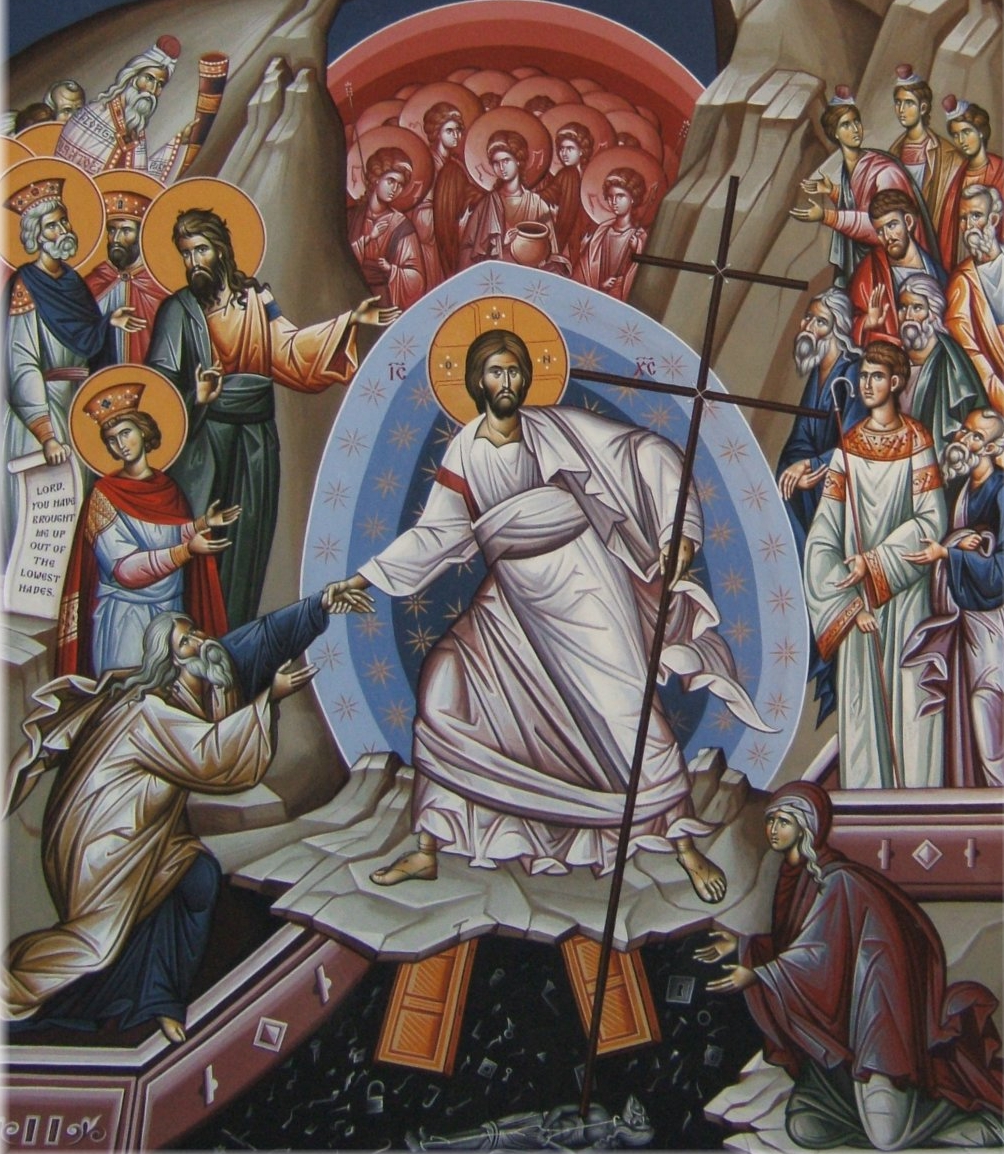
    Christ Descending into Hades

    The Orthodox Church is the original Church founded by Jesus Christ on the day of Pentecost, when the Apostles were gathered and received the gift of the Holy Spirit. For many modern Christians, there is little knowledge of what happened after the Bible was completed and the last Apostle died.

    A common idea is that soon after the Bible was completed, people began to misunderstand it and add their own beliefs to those found in Scripture. This led to the formation of various denominations. Seeing this division, but knowing that Christ is one, a closely-related theory proposes that therefore, as long as you believe the essentials, such as that God is a Trinity, Christ is God incarnate, and salvation is having one’s sins forgiven by Christ’s death on the Cross, you are a Christian, and that true Christians exist in each of these denominations and Churches.

    Unfortunately, these widely-held theories do not hold up to the historical record. Jesus Christ left no written record of his earthly life, and the writings of the Bible were not completed until some sixty years after his death. What is most startling, however, is that there was no agreed-upon list of what books constituted the Bible until the very end of the 4th century, when a series of councils were called to decide once and for all what was to be included in Scripture. Practically speaking, this means that for almost four hundred years, there was no Bible as we know it, and what kept the Christians together then was not a book, but a body—the Church—which continued from that time on and continues today. In fact, the Church is called the “pillar and foundation of truth” by Saint Paul in his First Letter to Timothy 3:15.

    It must be mentioned that there was only one Church through this time. There were false teachers and false beliefs being promoted, even in the New Testament times, but these false beliefs were rejected and if people insisted on them, they were to be avoided, so they would not cause confusion among the faithful. The Bible says: “A man that is an heretic after the first and second admonition reject” (Titus 3:10).

    Any difference of belief from what was handed down from the Apostles was seen as a break from the Church and from Christ. The Apostles appointed people to follow them, who are called bishops, and this line of succession continues until today. The Orthodox Church is the only Church which has maintained completely all of the teachings of Christianity without every adding, subtracting, or changing these teachings.

    What we believe has a direct impact on how we experience God and what kind of relationship we have with Him. For example, if we are driving and have a map that is wrong, we might not get where we are trying to go, but instead drive around in circles. If we believe incorrect things about God, we might never get to know Him truly. However, in the Orthodox Church, we can be sure that the priests and bishops are not making up their own ideas, but are passing down what they learned from their teachers, in a chain going all the way back to Jesus.

    Why do we need to go to any Church at all, though? Besides to make sure that we understand the Bible the right way and all of the teachings of the Christian faith, we also need to participate in the life of the Church. The Church is called the Body of Christ, because in it we share in His life. In Baptism, we put on Christ (Galatians 3:27). In the Church, we receive the forgiveness of sins (John 20:23), and when we receive Holy Communion, we are receiving the true Body and Blood of Christ—not just a symbol. Jesus says that if we do not receive Holy Communion, we do not have Him dwelling in us (John 6:53). It is only in the Church that we participate in these Mysteries. And by doing this, we join together as one body, breaking down the barriers that exist between people. Christianity is relational; to have a personal relationship with Christ, we need to be part of His Body.

    In every time and in every place, God has shown the power of His Grace which transforms the lives of people. Those who best exemplify this are given the title of Saint. Saints are our older brothers and sisters in the faith, who watch out for us along with the Angels.

    What Do I Do Next?

    Finding the right Church is not like going shopping for new clothes; we don’t decide which Church to go to based on the best sermon, the most activities, or which one we simply like the most. Instead, we need to look for the Church which believes and acts the same way as the Early Christian Church. Evidence will show that this is the Orthodox Church.

    The next step is for you to get into contact with an Orthodox priest and plan to visit an Orthodox parish. You should see the Church in action to get the full picture. The Orthodox Church appeals to all the senses: worship involves beautiful icons (images), incense, chanting, hearing the Bible read, and preaching. It is unlike anything you have ever experienced before!

    The Orthodox Church in the United States is small, and becoming an Orthodox Christian and living an Orthodox life afterward is not an easy thing. However, the benefits are far greater than the difficulties. We know that nothing good in life comes easily, but we also know that the reward of working hard and getting ahead is very sweet. If we think this way about our careers, how much more we should think this way about our spiritual life!