Tag: Old Calendar

  • Excerpt from “The Elder Ieronymos of Aegina” on How the Elder Returned to the Old Calendar in August, 1942

    Please Note: This is an excerpt from the work The Elder Ieronymos of Aegina, published by Holy Transfiguration Monastery, and under copyright. Please support the monastery’s translation work by purchasing this book. I’ve read it and highly recommend it.

    CHAPTER SEVENTEEN

    Lover of Tradition
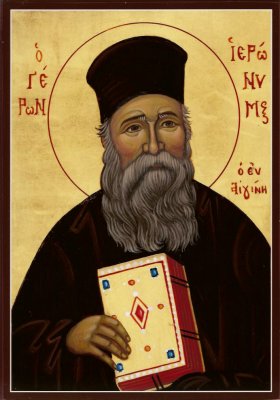
    The region of Anatolia, Cappadocia in Asia Minor, where he lived his childhood years, where he came to know the first spiritual stirrings, where he tasted the springing waters of Orthodoxy from the holy elders who lived there, and where he matured spiritually remained unforgettable for him. He frequently referred to his homeland and waved nostalgic for all the things he had experienced there. He never forgot the solitary chapels in the rocks, where one could go and pray in utter stillness, nor those simple people, those first-rate artisans, who, whatever they put their hand to, did it perfectly, with ardor, and with good taste.

    Being a great lover of the life of stillness and prayer, he often recollected the beautiful days full of spiritual ascents and exaltations that he had passed in the chapels and abandoned monasteries of his homeland.

    “Here in Greece you cannot find a quiet place to pray,” he was wont to say. “In Anatolia there were many places where you could pass the whole day in prayer, without anybody seeing you.”

    This insatiable and never-silent desire for quietude and prayer, for undisturbed communion with God, never abandoned him. He never lost an opportunity to draw apart and give himself to prayer. Usually, even when he was speaking to his visitors, he would stop for a little and say, “Now let’s chant something.”

    And he would begin with his imposing, deeply resounding, and melodious voice to chant “Let us worship the Word,” or “It is truly meet…” or some other hymn, these intermissions of prayer were indispensable for him, they were his life-breath, his spiritual supply-Iine. And at the same time, it was an excellent example for those who conversed with him, that they might form the habit of conjoining their every occupation with prayer.

    He lived the essence of Orthodoxy, tradition, in all its breadth. Without rejecting any of the attainments of technological society, he had a special weakness, a passion we might say, for whatever was olden, ancient-from material things to the spiritual. He liked the ancient order of the services, the old books, antiques, because he believed that they carried the seal of their maker, they had been constructed with fondness and were not machine-made and in bad taste.

    With such convictions and perceptions, having always lived his life within but also “outside this world,” within the strict province of tradition, he felt a certain uneasiness from the time that the ecclesiastical Calendar was changed and the new was enforced. These anxieties of his increased as the years went by and he beheld many Orthodox customs changed. He did not like the abridgement of the church services, the secularization of the clergy, the abandonment of the Orthodox way of life. And although he always attended to the essence and not the dim outward form, he believed that these alterations in traditional usages and forms in and of themselves betrayed a certain indifference and slackness towards the Faith: that this was the beginning of a downhill slide whose end was unknown. For this reason, he often thought of following the Old Calendar, especially since he saw that the Old Calendarists faithfully followed tradition and would not tolerate innovations and transgressions in matters pertaining to the Faith. For some time he hesitated, and prayed continually and fervently to God, that He might reveal to him His will. He awaited some sign, some indication from God, that would make it clear to him what he should do.

    In August of 1942, specifically on the 23rd of the month, [1] the eve of the feast of Saint Dionysius of Aegina, when the hospital church celebrated, Procopios, the then Metropolitan of Hydra, Spetsai, and Aegina, called him and told him to get ready so that on the morrow, on the occasion of the church’s festival, they might concelebrate. Many priests of Aegina, who knew that Father Ieronymos was sympathetic to the Old Calendar, but were ignorant of the vision he had seen, were under the impression that he had stopped liturgizing at the hospital church on account of his Old Calendarist sympathies. They reported this to the Metropolitan, and he, in order to ascertain the accusation, requested that they concelebrate. [2]

    Men of God perceive the finger of Divine Providence behind every action and occurrence. Father Ieronymos, who had stopped liturgizing some eighteen years before, considered this invitation from the Metropolitan to be God’s answer to his prayers. He prayed again all night long and finally decided not to go and concelebrate with the Metropolitan, but to follow the Old Calendar openly thereafter. He departed on the morrow from the hospital very early in the morning for the hermitage of the Annunciation of the Theotokos, where the Eldress Eupraxia was already staying.

    From there he sent the Metropolitan the following notification of resignation from the hospital church.

    To the Most Reverend Metropolitan of Hydra

    Kyr Kyr Procopios

    Aegina

    Your Eminence,

    I beseech you to accept my resignation from the hospital, because since 1924 and henceforward, my yearning and also my zeal have been for the Orthodox Church and the Faith.

    Since my childhood I have reverenced her, having dedicated my whole life to her, being obedient to the traditions of the God-bearing Fathers.

    I acknowledge and proclaim the Patristic Calendar to be the correct one, as you also attest. [3]

    For this reason I request of you, that you yourself also pray that I abide till the end a genuine child of the Orthodox Church.

    Kissing your Eminence’s right hand,

    I most humbly remain

    The servant of our Crucified Lord Jesus Christ,

    Ieronymos Apostolides

    Thus simply and quietly, without the beating of drums, excommunications, and fanatical manifestations, he followed the Old Calendar the rest of his life.

    This event did not in any way influence his behavior towards his spiritual children. He received them all without distinction, whether they followed “the Old” or “the New.” He never preached on the calendar issue. His foremost and principal aim was to instill into his visitors faith and love towards Christ; his chief care was how they progressed in the spiritual life, how they were united to God. He never took part in fruitless and harmful conversations concerning the calendar issue, even when he was challenged to do so. He contented himself with simply confessing that he followed the Old Calendar since “that’s the right one,” and that from the time the Church put the New Calendar into practice “things just have not been going well at all.” He never permitted immoderate and harmful fanaticism to prevail in his soul. On the contrary, he always strove to calm spirits. Once a visitor asked him, “Elder, do you follow the Old?”

    “Yes.”

    “Who are you with?” She meant, with which faction.

    “With all.”

    “But they have quarrels with one another.”

    “I am not with quarrels.”

    He was very discerning and refined in his ways. Even when he went so far as to censure, he did it with the utmost love, and not only did he not cause adverse reactions, but on the contrary he elicited confession and repentance, which was his intended purpose.
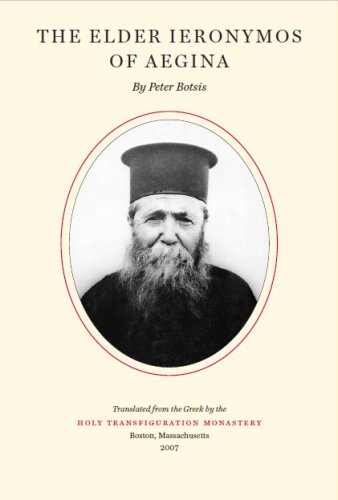
    Botsis, Peter. The Elder Ieronymos of Aegina. Brookline, MA: The Holy Transfiguration Monastery, 2007, pp. 159-163.

    ————-

    [1] That is, according to the New or civil Calendar; it was the tenth of August according to the Church (Old) Calendar. Since the feast of Saint Dionysius is August 24, the Elder Ieronymos was being asked to celebrate Saint Dionysius’ feast according to the New Calendar. —TRANS.

    [2] The truth of the matter is that Father Ieronymos, like his contemporary the holy Papa Nicholas Planas of Athens (+1932), quietly celebrated many of the feasts without liturgizing according to the Old Calendar. That he never liturgized or concelebrated according to the Papal Calendar since he had desisted from serving before the change of the calendar in 1924 was very convenient for him and somewhat eased his conscience. —TRANS.

    [3] Many, if not the majority, of the bishops and other clergy of the State Church of Greece at the time privately acknowledged that the Julian Calendar used by the Church since the days of our Saviour was the correct calendar for reckoning the feasts as opposed to the innovating Papal New Calendar; but for fear of reprisals, they would not proclaim this publicly. —TRANS.

  • New Calendarism, Vaganteism, and the True Orthodox Church

    In the last century, a new heresy permeated the Orthodox world, the heresy of ecumenism.  This umbrella term encompasses several related problems that have been eating away at Orthodox life for more than eighty years.  For the purposes of this article, we will use ecumenism as an umbrella term to refer to the problems of the branch theory, which imagines that the sacraments of the Church are present in various Churches that are not united and do not share the same faith, and modernism, which is at its root the assumption that modern man has the ability to diagnose the development of the Church’s tradition and make modifications as necessary, ignoring the organic development of the past several centuries.

    From the beginning of this heresy, Orthodox have resisted it.  These Orthodox are known by various names: True Orthodox, Genuine Orthodox, Traditionalist Orthodox, Old Calendarists, and Anti-Ecumenists, for instance.  In the beginning, Athonite monks provided the sacraments to those in Greece who refused to follow the first tangible aspect of ecumenism in the life of the common people: the calendar change of 1924, when the patristic calendar was jettisoned in favor of a crude hybrid Julian-Gregorian calendar (a calendar so flawed that in several thousand years Christmas and Pascha will coincide).  Later, in 1935, several bishops returned to the patristic calendar.  Later, as ecumenism increased, the Russian Orthodox Church Outside Russia (ROCOR) also experienced an awakening of anti-ecumenism.  In the 1960’s, the ROCOR and the Old Calendarist Greeks began to cooperate in witnessing traditional Orthodoxy: the ROCOR even provided the Greek Old Calendarists with bishops after the last Old Calendarist bishop reposed.

    In lands where Orthodoxy is not established, there is generally more confusion as to what constitutes authentic Orthodoxy.  With the heresy of ecumenism, the lines have become even more blurred.  Anti-ecumenism exists in North and South America, but what constitutes valid resistance to this heresy is not always obvious.  Due to the influence of false western ecclesiological ideas, such as the idea that apostolic succession exists outside the Church (and thus anyone ordained a bishop by “valid” bishops is himself a “valid” bishop as long as he can prove his “lines” of succession), combined with pride and ambition, and a desire for money, there have arisen a class of pseudo-Orthodox clergy who claim to be priests and bishops of the Orthodox Church.

    These bishops, called episcopi vagantes in Latin ecclesiological terms,  sometimes pretend to be Roman Catholic, sometimes Orthodox, or sometimes even combinations of their own creation.  Among the New Calendarists, these people are rightly rejected as being false clergy, but the problem becomes acute when innocent people begin to resist ecumenism and look for a new home.  This is because when searching for a traditional Orthodox parish, one often encounters these episcopi vagantes who claim they are Old Calendarists too.  Those looking for traditional Orthodoxy then end up farther away from it than when they started.  Therefore, one must understand the difference between a True Orthodox Church and a false Church staffed by episcopi vagantes, which we hope to make more clear by pointing out several indicators of a Church being false.

    The first clear indicator of a false Orthodox Church is one which appeals to “valid orders,” “valid apostolic succession,” or “ordination from valid bishops” and in this context oftentimes usually considers anyone from the Orthodox or Catholic Churches to have this “valid succession.”  A traditional Orthodox bishop would not appeal to such concepts because an Orthodox bishop is not made a bishop by those claiming descent from Roman Catholic bishops, or from bishops who he never communes with again, or made an independent bishop.  An Orthodox bishop must be part of a Synod which confesses Orthodoxy in an unbroken community, not simply a line of one bishop ordaining another—if a bishop breaks from other bishops and consecrates bishops, these ordinations are meaningless.  A bishop can only be created in the Church and for the Church, by people still in communion with the Church and with each other.

    Some would argue that because Old Calendarists are not in communion with the so-called “mainstream” Orthodox (i.e. the New Calendarists and those professing ecumenism, or those who are in communion with such persons), they are falling under their own judgment for not being in communion with the Church.  We must point out, however, that one of the criteria of true apostolic succession is bishops are ordained in the context of the Orthodox community, and not in schism or heresy.  Ecumenists, by their heresy, have cut themselves off from the Church, and as such, we must not have communion with them.  An episcopi vagante often does not have concerns about ecumenism, or traditional Orthodoxy, but rather is separate because of personal problems with the “institutional Church” or flaunt their “independence”—but do not resist any heresy.  What reason, then, do they need to be separated from New Calendarists, since one can only separate for questions of faith, and not for personal controversies?

    Some episcopi vagantes are anti-ecumenist, but then the question arises, why are they not in communion with the Orthodox Church (i.e. the True Orthodox)?  Again, one can only separate for reasons of faith, and yet some of these false bishops accept that ecumenism is wrong, and that the True Orthodox are right in their position, and they may even present themselves as True Orthodox, but they do not commune with the True Orthodox nor do they belong to a Synod of True Orthodox bishops?  One cannot be Orthodox and be independent of the Church.  If one is opposed to ecumenism, he should join the True Orthodox Church—not start his own.

    The other major problem of these false Orthodox are ambition and immorality.  Some are so interested in becoming clergy that they will do anything to be ordained.  When they are turned down from ordination in the New Calendar Church, suddenly they seek out alternatives to ordination.  Sometimes they briefly join the Old Calendar Church and successfully feign piety long enough to be ordained and leave.  But more often, they rush towards the most sure and quick way to be ordained: by seeking out episcopi vagantes, who are eager to ordain so they can build up their numbers on paper.  This double lust for worldly glory leads to disastrous results.

    Other clergy are simply immoral, and have been defrocked by other Churches; these people, having nowhere else to go, start their own Churches.  Sometimes, there are priests that are not immoral, but wish to become bishops while being married.  This is another sign of a false Church: married bishops. No Orthodox Church has married bishops, and there are no exceptions to this rule.  A false Orthodox Church will often have more clergy than parishioners, or its clergy will claim grand titles, like “Metropolitan Archbishop” when they only have one parish.  While size is not the main factor in determining legitimacy, having a consistent lack of parishioners while maintaining a large number of clergy, or having a consistently changing population of people (i.e. many coming and many leaving, so that at any given time most people are not the same people that attended a year ago) are other clues of being a false Church.

    Thus, if one is seeking the answer to ecumenism, he will find it in one place: the True Orthodox Church. In Greece, this is headed by Archbishop Kallinikos of Athens. In America, there is an Eparchial Synod under the presidency of Metropolitan Pavlos of North and South America.

  • Old vs. New Calendar: Frequently Asked Questions

    Q.  I’m Greek Orthodox but I’ve never heard of the “Old Calendar.”  Could you please explain what this means?

    A.  All Orthodox in the world used the Julian Calendar, which is currently thirteen days behind our modern civil calendar, until March 1924.  At that time, the bishops of the Church in Greece unilaterally converted their dioceses to the New Calendar, by deleting thirteen days at once, so that the religious calendar would coincide with the civil.  This means that Orthodox Christians across the world were now celebrating the important celebrations of our faith out of sync with each other, which impacted the unity of the Orthodox Church.  The majority of the Orthodox in the world did not accept this change, as is still the case in places like Russia, Serbia, Jerusalem, and Georgia.

    Q.  So the majority of the Orthodox in the world did not accept this change. Why did the Greek Church promote it, then?

    A.  Greece had just suffered the Catastrophe in 1922, and was destabilized internally between factions.  Those in power believed that the only way Greece could survive was to ally with the Western powers such as Great Britain.  The adoption of the New Calendar was seen as a way to cement ties with the Anglican Church and make the Greek people look more akin to Western Europeans to ensure greater political and cultural integration.

    Q.  Had the Calendar ever been an issue discussed before?

    A.  Yes. In the 16th century, when Pope Gregory XIII instituted the New Calendar, he wrote to the Orthodox to encourage them to accept it.  They refused, and condemned the Calendar on three separate occasions.  One of these Orthodox councils resulted in a document called the Sigillion of 1583, which condemned the New Calendar as incompatible with the Orthodox faith.

    Q.  Did anyone in Greece resist this change?

    A.  Yes. About 25% of the people and many of the priests in Greece at that time did not accept this change.  Many more priests were unhappy with the change, but they were threatened with loss of livelihood since the Church in Greece is not separate from the State (and, indeed, to this day, many Old Calendarist priests work a secular job and take little or no salary from their parish).  Monks from Mt. Athos, the center of worldwide Orthodox monasticism, came to serve them.  Some of the bishops who originally went along with the change tried to get it overturned privately, and when in 1935 they saw this was not going to happen, returned to the original Julian Calendar (now called the “Old”).  They ordained new bishops, and formed a Synod that maintained the traditional Calendar.  The State of Greece persecuted them, calling them “Old Calendarists” (Παλαιοημερολογίτες) which they meant as an insult.  The Old Calendarists preferred to call themselves Genuine Orthodox Christians (GOC), because they did not alter even one Tradition of the Orthodox Church.  These bishops travelled to other Orthodox countries to solicit support, but due to the volatile nature of the world at that time, none came.  These bishops eventually died, were exiled, returned to the New Calendar under threats, and one isolated himself and refused to commune with the others, forming a faction.  The last Greek bishop on the Old Calendar died in 1955.

    Q.  I thought a Church can’t exist without a bishop? What happened then?

    A.  That is true, and for this reason, the priests formed a committee and approached the Russian Church Outside Russia (ROCOR) for help.  Eventually, ROCOR bishops helped consecrate bishops for the Old Calendar Greeks.  Some of it had to be done secretly as the State of Greece would try to arrest anyone being ordained.  By 1969, though, once the situation was stable, the ROCOR issued all the necessary paperwork to demonstrate it accepted these ordinations and maintained full communion with the GOC.

    Q.  Why didn’t the other Churches help the GOC?

    A.  Over time, other changes were introduced into the Orthodox Church to make it more modern, and attempts were made to reach out to other Christians in a process called Ecumenism.  Ecumenism started off as a noble idea—try to get Christians back together—but being completely outnumbered and often intellectually overpowered, the Orthodox delegates (many of whom had studied in the West) gradually began to agree more and more with the non-Orthodox positions, rather than convincing the non-Orthodox to become Orthodox.  The Orthodox Church confesses that it is the original Church of Christ, and therefore, there can be no compromise in matters of faith.  These meetings were acceptable when it was simply people trying to overcome misunderstandings, but once joint prayers and joint statements began, the Orthodox delegates should have ceased.  They did not, and began to more actively support such bodies, such as the World Council of Churches.

    Q. You mentioned the Russian Church Outside Russia, but what about the one Inside? What did they have to say about this, since they stayed on the Old?

    A. In the Soviet Union, the Church there had been overtaken by the Communists, and those who refused to cooperate went underground, living in secret.  We consider these people the “Catacomb Church” and accept that they were Genuine Orthodox Christians as well.  The State-controlled Church there was used as a tool to promote the Communist party, and as such could not be recognized as a truly Orthodox body.  For all of these reasons, no support came to the Old Calendarists.  In fact, the Communists intended to eventually change the Calendar there, too; it was switched in Bulgaria in 1968 as a test case, but the formation of an Old Calendar Church there in reaction made them postpone the plans.

    Q.  Communism ended though. Why is that still an issue?

    A.  Indeed, communism ended, but those bishops who had been installed by the Communists for the most part did not resign or repent.  Generic “mistakes were made” type statements were issued, but no concrete repentance followed.  Most communist-appointed bishops continued to participate in Ecumenism, and those nominally on the Old Calendar continued to support the New Calendar in places where it had been adopted.

    Q.  So it’s not just about a Calendar then.

    A.  No, it’s about a general process in the 20th century to Westernize and modernize the Orthodox Church, and to push it in to union with the non-Orthodox Churches by means of political compromises.  The Calendar was in many respects the frontline of the battle; in fact, an Encyclical written by the Ecumenical Patriarchate in 1920 “To the Churches of Christ Wherever They May Be” outlined the change of calendar as just one of several points in a modernization scheme.  The Calendar, Ecumenism, and modernistic practices together have diminished the Orthodox faith, reducing it in many places to a purely secular and cultural phenomenon and hurting its spiritual power.

    Q.  Are you not recognized by the Greek Archdiocese (GOA), then?

    A.  The question might be posed in reverse: “do we recognize the Greek Archdiocese?” because we are, after all, the ones who remained faithful and did not change anything.  But no, there is no mutual recognition between the GOA and GOC.  Differing bishops and jurisdictions have differing views on the Old Calendarists from tacit support to sympathy to disdain.  We do not base ourselves off of their recognition, however, since again we are the ones who kept the faith purely, and our ordinations were conducted by and canonically recognized in 1969 by the Russian Orthodox Church Outside Russia, which no one could deny was a valid Orthodox Church.

    Q.  What would I have to do to become a member of this parish?

    A.  You can speak with our priest about this in private.  Our Church approaches the reception into communion of those coming from the New Calendar Church on a case-by-case basis.  The process varies because the people vary. Our goal is to build up the Orthodox faith in you, which you may not have been taught completely elsewhere.  We’re not interested in criticizing your past, but instead on taking the foundation you’ve received and helping you grow in the Orthodox faith.  We have to get to know you a little in order to do that.

    Q.  I can see this is a vibrant community and the people seem spiritually happy. I’m just not ready to commit because this is a lot of information I’ve never heard before. What do you recommend?

    A.  We are here for everyone, regardless of his or her affiliation.  Christ teaches us to minister to one and all.  You are welcome to attend liturgy, and participate as much as you are able as a guest. We do ask that you not approach communion in our Church until you’ve had a chance to make a decision and have spoken with the priest, but you are welcome to receive antidoron (blessed bread) at the end of liturgy.  We are also happy to pray the Mnimosino or other prayers for you and your family.  Take your time to get to know us, and we can provide you with any additional information you need.

    This was a booklet that I originally prepared to distribute to those visiting my mission parish from a New Calendar background, many of whom by this point were unaware that there even was such a thing as the Old Calendar Church. Its focus is pastoral in nature, rather than historical/doctrinal.