Tag: Orthodox Faith

  • Your Church Is in Grimesland? That’s Kind of Far from Greenville…!

    I grew up in the small town of Findlay, Ohio, which at that time had about 40,000 people. As a child, my mother would take me to get ice cream in the town of Jenera, which took a long time to drive to and was way out in the country. The attraction there was that they had Red Velvet flavored ice cream, which was apparently not available in Findlay at the time.

    A few years ago, the memory of that ice cream place came to my mind, and I decided to try and find it on Google (I didn’t; if anyone from Ohio knows, is it still there?) Checking the maps, I realized that Jenera was precisely 12 miles from where we lived in Findlay. I couldn’t believe how short of a distance that actually proved to be; as an adult, I drive 22 miles to go to my secular job every day!

    Distance is thus quite a relative concept, and this has been born out in our experience serving the Orthodox Christian community in the Greenville, NC area. Our parish is about 7 miles from the center of Greenville, and yet we have heard on more than one occasion from people whom we have invited to the Church that our parish is “kind of far” from the heart of town! Distance is relative, but is 7 miles really a difficult distance to commit to traveling once a week, let alone for a visit?

    To put this in perspective, I drive 90 miles to serve the community, a founding lay family drives 67 miles (they wanted to have the parish in Greenville so it could minister to the maximum number of people in Eastern Carolina), another core family travels 26 miles, etc. Those just mentioned come to every single service! Yet strangely enough, there are still those who would rationalize their non-attendance based on a 7 mile distance from the center of town.

    I know and they know that 7 miles is not the real reason they have not visited or are not attending regularly, so I just want to pierce through the excuses and say: if you knew that a buried treasure was 100 miles away, would anything stop you from going to recover it? Yet the greatest treasure of all—Holy Communion, the true Body and Blood of Christ—is only available in the Church, and this great gift is available for free each week. Besides Holy Communion, there is fellowship and many other blessings which are there, yet many take them for granted because it seems like there will always be a chance later to visit the Church or begin attending regularly.

    The question I have for such people is: are you sure about that? Do any of us know what will happen to us today? Will we tell God that 7 miles was “kind of far?”

  • My Father’s Church

    Orthodox people tend to want to stick to what they’ve learned from their parents. This is usually a good thing, as we learn from experience, observation, and repetition. Orthodoxy is not just a set of theoretical beliefs, but also a way of life. How we make the sign of the Cross, how we keep the fasts, and what songs we sing around holidays, are all examples of things we learn in the home.

    Some people of Greek descent are aware of the Old Calendar Church, but are hesitant to attend because they think it is not the Church that their parents attended. But if our parents (or grandparents) were born before 1924, they were actually born in the Old Calendar Church. In 1924, the bishops of the Church of Greece abandoned the Old Calendar, and the priests who depended on the Church for their salaries mostly followed. Many faithful, in some areas 25 percent, rejected this change, however, because the change in calendars had already been rejected by three councils in the 16th century, the bishops at that time foreseeing that allowing just one major change would open the door to many others. After the events of 1924, several bishops and priests eventually returned to the Old Calendar Church, after they realized their mistake. The Old Calendar Church continues today, and now even has a parish here in Greenville!

    The fact is, then, that it is not the Old Calendar Church of Greece that is “different” than the Church of our fathers. It is the New Calendar Church which has broken from the Orthodox Church as it existed in Greece before 1924. Why our parents or grandparents went along with the change is in many cases because they were forced, or did not understand the issue. But their fathers were on the Old Calendar, and so if we really want to belong to the Church of our ancestors, beyond just what our parents did, we should return to the Old Calendar. We are free to undo the change that was forced upon Greece in 1924, and this will have immense spiritual benefits in our lives as we return to a more traditional way of practicing the Orthodox faith.

    One thing is certain, however; if you don’t visit the Church, you will never be able to see for yourself who we are, and how we put these ideas into practice. You have nothing to lose from a visit, so we look forward to seeing you at our next Divine Liturgy!

  • Holy Week in Our North Carolina Missions

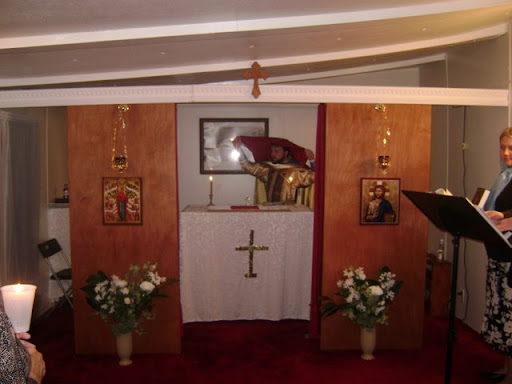
    Orthodox Holy Friday Services in Greenville, 2009

    Orthodox Holy Friday Services in Greenville, NC, 2009

    Whenever I visit our parishes, or speak to fellow Orthodox Christians, the topic of the missionary work we are doing in North Carolina always generates interest. I have previously written two articles concerning our missionary endeavors in North Carolina, “Our Missions in North Carolina” and “Our One Year Anniversary,” but for some time I have wanted to author another informal reflection to update our friends. Although it is now several months since Holy Week, that blessed time remains ever present in my heart and mind, so I will recount with joy how we celebrate this time in our missions.

    I continue to serve both our missions in Raleigh (St. Mark the Evangelist) and Greenville (Nativity of the Holy Theotokos) regularly; generally speaking, three times a month in each location, by a combination of Saturday and Sunday liturgies. I maintain a secular job to support myself, and my on-call rotation has increased, so scheduling is often challenging, but God has always blessed it to work out in the end. I also occasionally find time to visit my other mission station, in Charlottesville, Virginia, or to provide pastoral care for families who have found us elsewhere and are hopeful to establish a mission, such as the folks in Nashville, Tennessee.

    (more…)

  • Redefining Church?

    Redefining Church?

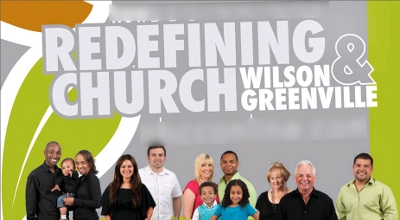
    When I come to Greenville for liturgy three times a month from Raleigh, I take U.S. Route 264, which brings me right by the town of Wilson, N.C. The few times I’ve stopped there for gas or food, I’ve been impressed by its small-town charm, and have prayed that someday there will be an Orthodox Church there.

    'Redefining Church': A Billboard on US-264 near Wilson, NC

    For several months, I have noticed a certain billboard as I pass by the town. It is for a Church that has campuses in both Wilson and Greenville, and it states boldly: “Redefining Church.” I am suspicious of slogans in general, but all the more so when they are related to Church. When they express an idea that is incorrect, I feel frustrated.

    That is exactly the feeling I get each time I see this billboard. I want to make it clear that I do not judge the sincerity of the Church’s pastors and staff, and I have no desire to disparage any good work they may be doing in their community. For this reason, I will not name the Church. But I do feel an obligation to point out where this message falls short of the Gospel of Our Lord, God, and Savior Jesus Christ.

    What do Churches like this one mean by “Redefining Church,” anyway? Often they arise in reaction to what they perceive as the stuffy, spiritually dead atmosphere found in mainline Protestant congregations. Just as in the 16th century, Martin Luther was faced with the Roman Catholic Church, which had replaced a personal relationship with Jesus with a formalistic, cold religious system, our modern Churches believe that even Protestantism has now become formalized and stuck in the past. The process of Reformation must continue.

    (more…)

  • The New Testament Church

    When you sit down to think about it, there sure are a lot of Christian denominations: Baptists, Lutherans, Methodists, and Episcopalians, to name a few. Is this what Jesus wanted? The Bible says that Jesus is the head of the Church (Ephesians 5:23). Can a head be a head to more than one body? Some have come up with a theory that the Church must refer to all the saved Christians on the earth at one time. Yet the Bible also says that the Church is the “pillar and foundation of the truth” (1 Timothy 3:15). If the Church is an invisible group of all the saved Christians, then where is there a pillar or a foundation that we can look at for guidance? This would lead to a lot of confusion, for sure. We’d have to go and ask each minister we knew, and they might give different answers. In the end, we’d have to rely on our judgment: but what if we are wrong?

    Some claim that they are “Non-Denominational.” While the idea of not being a denomination is a good start, it’s pretty obvious that most Churches which claim to not belong to any denomination look a lot like your average Baptist or Evangelical Church. It’s very rare, for instance, to see a Non-Denominational Church that looks Roman Catholic. Changing the sign on the door doesn’t restore us to the original, pre-denominational Church. The question we might ask is then: what was the Church like in the early days right after Jesus, in the New Testament? And does that Church still exist?

    Returning to the Bible, we see that the Church was started on Pentecost, when the Holy Spirit descended upon the Apostles and they went out to preach (Acts 2). 3000 people were converted and baptized that day. St. Paul travelled and converted many people. He wrote them letters, and those letters became books of the New Testament, the second half of the Bible. He also told them things verbally, and expected them to honor his oral traditions: “So then, brothers, stand firm and hold to the teachings we passed on to you, whether by word of mouth or by letter” (2 Thessalonians 2:15).

    After the Apostles died, what happened next? For instance, if there was a problem or a dispute, who settled it? Correct doctrine was certainly important; leaving aside the correct teaching about Christ was considered to be leaving God (2 John 1:7-11). Did they turn to their Bibles for the answer? Besides the fact that most people could not read then, the Bible was not all together in one place at that time. Certainly, the Old Testament Scriptures were collected in scrolls, but the Gospels and Epistles were still being circulated and collected. There were also some false Gospels and Epistles that taught incorrect things about God. In fact, the Bible contains no divine “Table of Contents” at all! It was only in 393 AD at the Council of Hippo that the bishops assembled agreed on the official list of books of the Bible! The criteria they used was comparing what Epistles and Gospels had been collected in each local Church they served, and which had been read in the Sunday service continuously. An ancient saying went, “what you pray, is what you believe.”

    To people used to the idea that the Bible is the only source of authority for the Christian, this fact might seem scary at first. But it really isn’t: as we mentioned above, the Bible says that the Church is the pillar and foundation of the truth. Looking at history, we see that the Apostles selected overseers (bishops) to succeed them and maintain order. A well-known example mentioned in the Bible is Timothy. These bishops continued to select people to succeed them, as an early Christian writer recorded (Ireneus in his work Against Heresies in the second century, for instance). This is referred to as “apostolic succession”: the apostles chose successors who chose successors down to the present day. As each bishop was selected, he made a public profession of faith, and was entrusted with the written letters of the Apostles and the oral traditions that had been passed down to his predecessor, and which had been publicly taught in the assembly of prayer. This public succession prevented people from claiming they had a secret teaching about God or that they had secretly been made bishops. When there were regional problems, the bishops of each local church would meet together in councils, such as Hippo in 393 which confirmed the proper list of books of the Bible.

    This succession of bishops continues to this day: in the Orthodox Church. All Orthodox priests and bishops have been ordained by bishops that can be traced back to the Apostles. Apostolic succession is an important link confirming that the New Testament Church is alive today, because the succession of bishops is older than the Bible itself! The Orthodox Church has not been founded by any individual, such as Lutherans being founded by Luther, or Baptists being founded by John Smyth. These Churches do not have proper apostolic succession. The Roman Catholics have a physical line of bishops, but they have changed doctrines over time, and separated from the majority of other bishops in 1054 over the issue of the Pope.

    The Orthodox Church is the original Christian Church, which has faithfully preserved the doctrine and practices of the Early Church. In this day, many are looking to rediscover the New Testament Church, and are often surprised to learn that it has been there all along. Orthodoxy is not just another denomination, but is pre-denominational. If you’ve ever wondered what happened after the Apostles or what the Church looked like in 200 AD, 500 AD, or 1300 AD, come worship with us and get a glimpse at the Church as it has existed throughout all ages.