I’d like to direct my readers to a YouTube channel my friend Sharon just started concerning her journey through life struggling with a corn allergy. While that might not immediately seem like the kind of thing for me to post on my website, I have noticed that a lot of traditionalist Orthodox Christians are interested in the subject of alternative medicine, food allergies, non-GMO, etc., and I know some who themselves suffer from similar ailments, so I figured it might be of “crossover interest” and possibly helpful to someone if I posted the link. I also think Sharon is a cool person and deserves to have her work more widely known. 🙂
On Monday, our dog Peluche started acting strange, became lethargic, got glassy eyes, layed down, and died.
He was a small dog, and only 10 years old, which means for a small dog, he was probably too young to die. My first dog, by comparison, lived to be 17 years old, which is ancient by dog standards. He probably suffered a heart attack or a stroke, but his departure from this world was quite sudden regardless of the causes.
The death of a pet is always a sad event. God did not invent death—that was the consequence of Adam’s sin, which could have been avoided—but God allows all things for our benefit and salvation. In the case of the death of a pet, or of a loved one close to us, or of a famous celebrity, the “takeaway” is the same; we are quite possibly next, so let’s get to the business of preparing for it.
How do we prepare for death?
1) Acknowledge that we cannot save ourselves, and that we need Jesus Christ to be reconciled to God the Father.
2) Seek out the Church where Christ is made present and His teachings are preserved wholly unchanged (i.e. the Orthodox Church).
3) Begin to read Holy Scripture (the Bible) regularly and seek to apply its principles to our daily life.
4) Begin to pray and fast in preparation for Holy Baptism.
5) Receive Baptism at the hands of a canonical priest.
6) Confess our sins before God directly and our fellow man (the priest serves as a representative of the community in modern practice) when we fall after our baptism.
7) Receive Holy Communion frequently to renew the life of Christ within us.
8) Engage in activities that mortify the flesh and remind us of our final end (fasting, almsgiving, pilgrimages, and spiritual reading).
9) Pray without ceasing until our final breath.
Regardless of where you are in the above list, let the death of your pet, loved one, or favorite celebrity shake you, wake you up, arouse you from your slumber, slap you across the face—whatever it takes, however you express it—change, and begin your new life, NOW!
Part of my ongoing Correspondence series, featuring replies to people who contacted me and asked questions, mostly when I served as a priest (2008-2013).
What is your take on this? Very strongly worded. The list of signers is impressive.
I rejoice when people in the New Calendar Church make the correct confession, but here are a few points to consider:
1) This is the latest in a series of such statements. If you see the one (and only!) Romiosini we put out in 2007, we republished similar statements that were made then. It raises the question: how many statements do they need to make before they do something about it?
2) They do not include New Calendarism in the category of Ecumenism for obvious reasons; if they did, they would have to conclude that they fall under their own anathema.
3) The signatories to this statement are the usual crowd. Fr George Metallinos, Fr Thomas Zisis. Other members of the New Calendar Church ridicule them behind their backs–I have seen this first hand when I was in the seminary, where the dean of St Vladimir’s referred to Fr George as basically a crackpot.
4) Metropolitan Seraphim of Piraeus just wrote a blazingly arrogant piece against us, totally unprovoked. You can see our response (in Greek) on ecclesiagoc.gr
That being said, I am hopeful, but in a way most people do not anticipate. After the Council of Nicea in 325, the group that remained faithful from Day 1, the Orthodox, are referred to as “Old Nicenes” by scholars. They confessed “homoousios” ie. that Christ is the of the same substance as the Father. The compromisers, who arose under the heretical Emperors that succeeded St Constantine, confessed “homoiousios” ie. that Christ is of similar substance to the Father. They remained in communion with the Arians and are termed semi-Arians by many scholars.
At some point, the Arians became more extreme and confessed Eunomianism–Christ is not of the same substance as the Father. This finally scared the Semi-Arians, who broke communion with them and joined communion with the Old Nicenes. They became known as New Nicenes as they were the “johnny come latelies.” Together, these two groups vanquished the Arians.
In our modern situation, I believe that we are the Orthodox and that the conservative New Calendarists are like the Semi-Arians/New Nicenes. If they follow their consciences they will eventually break communion with the blatant heretics and join with us, and together we’ll win. That’s my opinion for what it’s worth. I therefore support reaching out to these people, and having good relations with them, not being too antagonistic towards them, while at the same time reminding them that as long as they are with the Ecumenists, they are not doing anyone any good. Also, we will have to be patient with them, as they will continue to lash out at us like Metropolitan Seraphim of Piraeus did, because we prick their conscience.
in Christ,
Fr Anastasios
Postscript: The above-mentioned statement against Ecumenism was published in 2009. Nothing has come of it whatsoever in the intervening five years. In fact, as I edit this post for publication on my website, Patriarch Bartholemew of Constantinople is preparing to meet Pope Francis in Jerusalem to commemorate the 60th anniversary of the so-called “Lifting of the Anathemas,” which inaugurated a syncretistic ferver with Roman Catholicism.
It was a blessing to be able to travel to Astoria, New York the weekend of April 27-28 (May 10-11 on the civil calendar) to attend the Enthronement of His Eminence Metropolitan Demetrius as the new Metropolitan of America and president of the Holy Eparchial Synod of the Church of the Genuine Orthodox Christians of America. This event marked both a new page in the life of our Metropolis and Eparchy in America, and also was a witness to the recent Church union which occurred in March, when ten bishops of the former Synod in Resistance united to our Synod and through them we entered into full communion with the Russian Orthodox Church Abroad under Metropolitan Agafangel, and the Romanian Old Calendar Church under Metropolitan Vlasie.
Both Metropolitans Agafangel and Vlasie sent episcopal representatives to this event (Archbishop Andronik of Syracuse, and Bishops Iosif of Botoşani and Dionisie of Galaţi), who joined the two Metropolitans sent from Greece (Metropolitans Chrysostomos of Attica and Gerontios of Piraeus), the American-born bishops resident in North America (Metropolitan Moses of Toronto, and Bishops Christodoulos of Theoupolis and Auxentios of Photike) and Metropolitan Pavlos, the former Metropolitan of America, whose retirement in late 2013 opened the path toward the Election and Enthronement of Metropolitan Demetrius. There were also twenty-two priests and eight deacons serving.
I left my home in Reston, Virginia early Saturday morning, in order to be able to travel peacefully and without feeling rushed. There was no traffic, and I arrived at the Cathedral of St. Markella around 1:00 pm. One of the things I most like about the Cathedral is that it is open every day from around 8:00 am to 8:00 pm for Christians to come and pray and light candles, and attend services should they be occurring. There have been daily services in the morning and evening almost without interruption since its founding in 1954. One can only speculate as to how much the city of New York has benefitted from these prayers, and what would have happened were they not occurring continuously.
I felt a bit of trepidation in my heart, because this was the first time returning to the Cathedral since I resigned from serving as a priest in April 2013 for personal reasons. My resignation came as a surprise to many, and I certainly let people down. I stayed away for some time to give things time to settle, but it was high time for me to return and see my old friends and associates. If anyone were to react toward me negatively, it certainly would have been good for my soul, but everyone was fair toward me and some were quite encouraging. I appreciated more than one person telling me that he had been praying for me and my family throughout this whole time.
The Calm Before the Storm!
The Organizing Committee was busy doing the last-minute staging, so I sat quietly in the Church for several hours, praying, thinking, venerating icons, and just taking in the scene. A few old friends stopped by and said hello. A Synod meeting was occurring, so the clergy was mostly occupied. Around 3:00, the Synod meeting ended, and I was able to greet the bishops. I saw my ordaining bishop Metropolitan Pavlos for the first time in a year, and it was an emotional time. He was greatly disappointed in me, and yet when he saw me, he was compassionate and loving. I saw Metropolitan Chrysostomos of Attica, with whom I had served twice as a priest during concelebrations, and he offered me his prayers and counsel. My spirits were already being lifted up.
Around 5:30, Vespers began, with chanters from Chicago, Boston, and New York joining together to form a magnificent Byzantine choir. The chanting was excellent. I was especially happy that this weekend was the Sunday of the Paralytic, and the happy-sounding Mode 3 was the appointed mode, which made things especially joyous sounding. Vespers continued for about an hour, and afterward, we were served a delicious meal downstairs by the women of St. Markella’s, with help from other faithful serving us. I had the opportunity to speak to some of the other bishops and clergy, as well as my Koumbaro and Koumbara (my daughter Sophia’s godparents), and make the acquaintance of some of our Detroit faithful whom I had not previously met. I made it back to the hotel at 10:00 pm, checked in, got some midnight snacks, and uploaded photos and videos from the day.
Exterior of the Cathedral of St. Markella
I intended to make it to Matins at the beginning, which was around 7:00 am, but human weakness being what it was, I overslept and made it at 8:45, just missing the censing during Matins and the singing of “More Honorable Than the Cherubim.” It was a warm day, and being someone who has visceral reactions to cold weather, I felt comfortable in the warm sunlight and walked from my parking spot to the Cathedral. The prayers during the Spring and Summer, when the doors are opened, could be heard on the street, and occasionally someone driving by would stop and look in the Church to see what was going on there.
The Matins and Liturgy was an extremely long service, due to it being a Hierarchical (bishop-led) service and due to the Enthronement elements being added on. Metropolitan Demetrius entered the Church, and was vested in the middle of the Church, which is something common among Russians, but almost never seen in Greek parishes. I asked some faithful if they had ever seen it before, and they replied that they had not. The Church continued to fill up. At the singing of the Thrice-Holy Hymn (Agios O Theos), there was a prayer read for the new Metropolitan, while he stood in the high place behind the altar. This was the second element of the Enthronement ceremony. Hymns were chanted in Greek, English, Slavonic, and Romanian.
Bishop Auxentios’s Speech
At the conclusion of the Divine Liturgy was the final part of the Enthronement ceremony, where the new Metropolitan ascended his throne, various prayers were read, and an Encyclical from the Holy Synod was read in English and Greek. Various people made speeches, including a rather touching speech by His Grace Bishop Auxentios, who remarked on how in his earlier life he had been at the Cathedral (he had been baptized at our parish of St. Isidoros in Long Island by Bishop Petros’s brother Fr. Niphon in the 1970s) before departing for monasticism elsewhere, and due to the unfortunate splits in the Old Calendar Church in the 1970s and 1980s, finding himself in the afore-mentioned separate jurisdiction which recently united with us. He came full circle and was back where he started, much to his joy and ours. Some of the children of the Greek school made short speeches to the Metropolitan, and Gerondissa Synclitiki, who knew Metropolitan Chrysostomos of Florina, the second leader of the GOC (1937-1955) spoke of her joy.
Clergy at the Banquet
After the Liturgy ended, we went to the Chian Federation for the banquet. This banquet was a great opportunity for fellowship and for old friends to be reunited. There were several additional speeches, including a moving speech by Metropolitan Moses of Toronto, and by Bishop Iosif of Botoşani, who spoke in Romanian with an interpreter interpreting into English. He provided Metropolitan Demetrius with an icon of St. Glicherie, the Old Calendarist confessor of Romania, and icon prints to all present. The Cathedral of St. Markella provided the Metropolitan with a new staff. The Byzantine choir chanted various selections to the delight of the audience.
The banquet wrapped up around 7:00 pm, and after seeing my Koumbari again, I left to return to Virginia, spiritually renewed. Many Years to our new Metropolitan!
When I served as an Orthodox priest, I often got strange phone calls, which was rather similar to the situation when I worked at a law firm in my early 20s. People love to call up priests and lawyers randomly to get advice. I was going through some old Facebook posts and found this post that I made in May 2012. I thought I would share it because on the one hand, it is kind of funny, but on the other hand, it does demonstrate the state that many people are in and where their concerns are. A priest tries to use such contacts to segue into an invitation to visit the Church, but sometimes the conversations just get…strange and confusing… I did pray for this individual for some time, but I never got a chance to meet him in person, unfortunately.
Today’s random phone call I received went like this:
“Father, this is so-and-so; we met a few months ago. My daughter wants to get a tattoo of her son’s name, but in Greek letters since we are of Greek descent. Can you tell me if there is a Greek version of the name such-and-such?”
“As a priest, I must advise you that getting a tattoo is not a good idea; God made you a certain way, so why would you want to alter your body?”
“I can respect that position. It was either Chinese or Greek letters though, so I suggested Greek letters at least.”
“While I can’t recommend she get a tattoo for the previously-mentioned reasons, I would point out that there is no Greek equivalent to the name you mention.”
“So we should go with Timotheos, then?” (he never mentioned who Timotheos/Timothy is).
“Again, I don’t think getting a tattoo is right at all, but Timotheos is a saint’s name, yes. That being said, I highly recommend against your daughter getting a tattoo.”
“Thank you Father. I can see where you are coming from, and I can respect that.”
Part of my ongoing Correspondence series, featuring replies to people who contacted me and asked questions, mostly when I served as a priest (2008-2013).
Dear Father Anastasios,
Thank you for your message.
At the moment I am with ROCiE, but am wondering where to look within Orthodoxy for doctrinal purity without a rigid, cold, legalistic mentality.
So, for your thoughts on one question, please, I would be grateful.
Where might I find Orthodox Christians who have a pure confession of the Faith (eschewing ecumenism) but do not have their knives out?
Please forgive the bluntness of that question; but I am becoming a bit disillusioned after seeing how the various groups within Orthodoxy appear to hate and revile one another. Where amidst all this skullduggery is the vehicle of salvation?
Sincerely,
D.
Dear D.,
The simple question as to where you can find Orthodox Christians without their knives out is to start with yourself. Make sure you are always at peace with yourself and others. Then you will draw in people of like mind.
But as for the broader question, there is no place in the world where there is a perfect confession of faith coupled with perfect people. If you keep looking, you will never find it.
What you can find is the proper confession of faith, and you can find people in that Church that are struggling to live pious lives, and you can join with them. But you will run in to people in that same Church that have knives out. Only Christ will separate the wheat and the chaff. There can be no salvation without temptations to overcome.
Notes on the Gospel Reading for the Sunday of the Paralytic (John 5:1-15).
The Cleansing ritual
This pool was outside of the Temple, and used to wash down the sacrificial lambs
The sick thus participated indirectly in the sacrifices of the Temple
The grace was limited to the first person to enter, and was mediated by Angels
As a type of the Christian baptism to come
Through water comes the healing
“An angel” so that they would know that divine power is working through this water, not just the water itself
Baptism is a direct participation into Christ’s death (Romans 6:3) and Resurrection
Baptism is available to all nations and the grace of baptism is never extinguished
Christ singles out the Paralytic, a man who has waited 38 years, to teach us to have perseverance, and as a judgment against those who lose hope or patience with God during far shorter trials
Christ’s Dialogue with the Paralytic
Christ asks the Paralytic if he wishes to be healed
To publicize the man’s 38 years of perseverance in the face of hopelessness
To underscore that not everyone who is sick actually wishes to be healed; some prefer to wallow in their illness, to receive the pity of others
The Paralytic responds that he has no man to help him. This is to show that it is not just the water that heals, but it comes with the help of a man. Christ is the man who has come to help him and all other people be healed and set free
Faith contrasted with Legalism
The Paralytic is healed, but the Pharisees find fault, because he carries his bed on the Sabbath; they miss the forest for the trees
The Paralytic goes to the Temple to thank God immediately, because of his faith
Physical infirmity and sin
“Sin no more lest a worse thing come upon you.” St. John Chrysostom teaches that in this case, the man’s sin led to his illness
Sin and illness are not always related, but sometimes they are
Regardless of whether they are related, the man is commanded to sin no more, because worse things will happen to him, i.e. eternal damnation
When we are granted a healing by God, we must remain healthy and free from sin, lest having been saved, we fall away
I’ve enjoyed writing since I was little, and I have written for a variety of reasons. Writing is an interactive process for me; I am as excited to see the reaction to and engagement with what I produce as I am to produce it in the first place. Sometimes I write for personal reasons, such as self-expression or as a process of deepening my own understanding, and sometimes I write to share information, because some things are so magnificent and interesting that they deserve to be more widely known. Writing is also a good way to learn, especially online, where so many resources are available and so many knowledgeable people exist to challenge one. I also write to spread awareness of my faith, the Orthodox Christian faith, which has helped me greatly in my life and which I believe can help others achieve salvation and spiritual enlightenment. Finally, I often write as a service to others, by helping them put on paper ideas and thoughts they were not able to do so themselves.
My “day job” has been in the computer networking industry for the past seven and a half years. I enjoy my work, and am thankful to have maintained a job steadily through the tough economic times we’ve experienced in the United States. My job is intellectually challenging in its own right, and I am constantly trying to augment my skillset and marketability by taking on diverse projects and studying and obtaining new certifications (hands-on and theoretical both, to be well-rounded). Most likely, I will need to continue in this field for the next several years. I am not, however, as passionate about networking as I am about writing.
As time goes on, my writing becomes more and more important to me, and I find myself doing it more. At present, almost everything I have written has been free, for one of the reasons stated in the first paragraph. I will continue to produce free content, God-willing, for the rest of my life. However, I also would like to be able to make writing a part-time and possibly even a full-time profession.
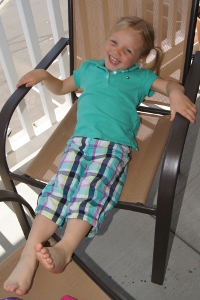
My Daughter Sophia, May 2014
As a result of choices I made, I am in a situation where I reside in Virginia, but travel to North Carolina almost every other weekend. With a career as a writer, or even a solid part-time income stream, I would be able to maintain a modest apartment, condominium, or townhouse in North Carolina in addition to my home in Virginia. This will be very important for my relationship with my oldest daughter Sophia, who lives in Raleigh. If I were able to write full-time, I would even be able to go back and forth at will, which would significantly improve my family life.
I would also be able to produce more content, because I would not be splitting myself between multiple areas. With a focus and a commitment, and the hours necessary to accomplish the goals, I would be in a position to produce more of the content that you readers have come to enjoy. Also, I would be in a position to help with our Church’s missionary aims in a more direct way, as I would be free to assist our holy priests in their missionary work were I able to set my own schedule. Despite my own mistakes and setbacks, missionary work remains constantly on my mind. I still want to see missions and eventually parishes established throughout Virginia and North Carolina (and beyond), and not just in the big cities.
One nonfiction work—an eBook—is about to be published, and I am also working on some religious fiction short stories. Finally, I am doing research on various nonfiction projects. I also am working to monetize my blog via advertising revenue, and am actively soliciting freelance projects (which do not have to be religious in nature). I’ve read the arguments between those who say find a niche, and those who encourage writing in multiple areas (some say with different pen names for different genres), and I’ve taken that all into consideration. To start, I’m going to go with my gut instinct, and see what works and what doesn’t.
To be successful, I have read that one needs to set goals. I’ve also read that one should make these goals clear to others to boost the follow-through and accountability. For that reason, I am going to set some now, although I am fully cognizant that ultimately it is God’s grace and not self-realization and other modern pop psychobabble that will get me there.
By September 1, 2014, I will be generating $250 a month in writing income
By January 1, 2015, I will be generating $750 a month in writing income
By June 1, 2015, I will be in a position where I have paid off certain debts and can pay for a dwelling in North Carolina
By June 1, 2016, I will be in a position to consider my full-time career options
Thank you for listening, and if you want to be part of “Team Anastasios” then please:
Purchase my works as they are published
Let others know about this blog (“sharing is caring”)
Hire me to write (or speak—I’m told I’m rather good at that) for you or your organization
Pray for me
Send me suggestions and leads
Subscribe to my blog to be made aware of updates and so I can show I have a loyal following when I submit works to publishers