Category: Excerpts

  • Excerpt from Upcoming Book: Finding the True Orthodox Church

    The following is an excerpt from my upcoming book, Finding the True Orthodox Church. The book consists of a series of chapters which address various objections to True Orthodoxy. This is the introduction to a chapter which addresses the question, “Are True Orthodox Vagantes?” This charge is sometimes leveled against the True Orthodox, by comparing them to various pseudo-churches with no legitimate heritage, in an effort to paint the True Orthodox as pretend clergy and poseurs. The chapter will explore the differences between True Orthodox and Independent Orthodox (i.e. vagante) groups, to demonstrate that the two movements have nothing in common, despite the fact that some Independent Orthodox groups call themselves True Orthodox.

    Introduction

    Orthodox Christians living in the West have benefited from certain relative freedoms available to them which were not available in the Old World. However, with these new opportunities came new challenges. Especially after the confusion of the October Revolution in 1917, the Orthodox Church in the West became jurisdictionally fragmented, and in the midst of this disorder arose competing bishops and jurisdictions—a canonical irregularity and a serious scandal to all conscientious Christians. With no governmental authority to intervene, and given the chaos that was prevalent in many of the Old World patriarchates due to war and upheaval, the reality of an unhealthy situation was accepted as unavoidable. Out of this confusion arose bishops who were no longer affiliated with any established Orthodox synod or local church, and dozens of independent parishes. (more…)

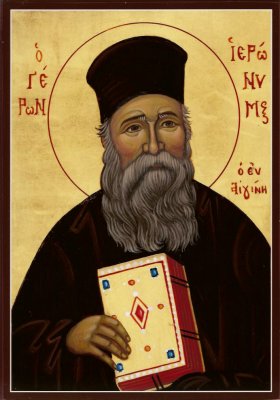
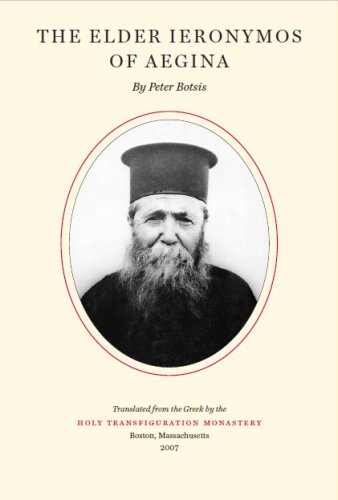
  • Excerpt from “The Elder Ieronymos of Aegina” on How the Elder Returned to the Old Calendar in August, 1942

    Please Note: This is an excerpt from the work The Elder Ieronymos of Aegina, published by Holy Transfiguration Monastery, and under copyright. Please support the monastery’s translation work by purchasing this book. I’ve read it and highly recommend it.

    CHAPTER SEVENTEEN

    Lover of Tradition

    The region of Anatolia, Cappadocia in Asia Minor, where he lived his childhood years, where he came to know the first spiritual stirrings, where he tasted the springing waters of Orthodoxy from the holy elders who lived there, and where he matured spiritually remained unforgettable for him. He frequently referred to his homeland and waved nostalgic for all the things he had experienced there. He never forgot the solitary chapels in the rocks, where one could go and pray in utter stillness, nor those simple people, those first-rate artisans, who, whatever they put their hand to, did it perfectly, with ardor, and with good taste.

    Being a great lover of the life of stillness and prayer, he often recollected the beautiful days full of spiritual ascents and exaltations that he had passed in the chapels and abandoned monasteries of his homeland.

    “Here in Greece you cannot find a quiet place to pray,” he was wont to say. “In Anatolia there were many places where you could pass the whole day in prayer, without anybody seeing you.”

    This insatiable and never-silent desire for quietude and prayer, for undisturbed communion with God, never abandoned him. He never lost an opportunity to draw apart and give himself to prayer. Usually, even when he was speaking to his visitors, he would stop for a little and say, “Now let’s chant something.”

    And he would begin with his imposing, deeply resounding, and melodious voice to chant “Let us worship the Word,” or “It is truly meet…” or some other hymn, these intermissions of prayer were indispensable for him, they were his life-breath, his spiritual supply-Iine. And at the same time, it was an excellent example for those who conversed with him, that they might form the habit of conjoining their every occupation with prayer.

    He lived the essence of Orthodoxy, tradition, in all its breadth. Without rejecting any of the attainments of technological society, he had a special weakness, a passion we might say, for whatever was olden, ancient-from material things to the spiritual. He liked the ancient order of the services, the old books, antiques, because he believed that they carried the seal of their maker, they had been constructed with fondness and were not machine-made and in bad taste.

    With such convictions and perceptions, having always lived his life within but also “outside this world,” within the strict province of tradition, he felt a certain uneasiness from the time that the ecclesiastical Calendar was changed and the new was enforced. These anxieties of his increased as the years went by and he beheld many Orthodox customs changed. He did not like the abridgement of the church services, the secularization of the clergy, the abandonment of the Orthodox way of life. And although he always attended to the essence and not the dim outward form, he believed that these alterations in traditional usages and forms in and of themselves betrayed a certain indifference and slackness towards the Faith: that this was the beginning of a downhill slide whose end was unknown. For this reason, he often thought of following the Old Calendar, especially since he saw that the Old Calendarists faithfully followed tradition and would not tolerate innovations and transgressions in matters pertaining to the Faith. For some time he hesitated, and prayed continually and fervently to God, that He might reveal to him His will. He awaited some sign, some indication from God, that would make it clear to him what he should do.

    In August of 1942, specifically on the 23rd of the month, [1] the eve of the feast of Saint Dionysius of Aegina, when the hospital church celebrated, Procopios, the then Metropolitan of Hydra, Spetsai, and Aegina, called him and told him to get ready so that on the morrow, on the occasion of the church’s festival, they might concelebrate. Many priests of Aegina, who knew that Father Ieronymos was sympathetic to the Old Calendar, but were ignorant of the vision he had seen, were under the impression that he had stopped liturgizing at the hospital church on account of his Old Calendarist sympathies. They reported this to the Metropolitan, and he, in order to ascertain the accusation, requested that they concelebrate. [2]

    Men of God perceive the finger of Divine Providence behind every action and occurrence. Father Ieronymos, who had stopped liturgizing some eighteen years before, considered this invitation from the Metropolitan to be God’s answer to his prayers. He prayed again all night long and finally decided not to go and concelebrate with the Metropolitan, but to follow the Old Calendar openly thereafter. He departed on the morrow from the hospital very early in the morning for the hermitage of the Annunciation of the Theotokos, where the Eldress Eupraxia was already staying.

    From there he sent the Metropolitan the following notification of resignation from the hospital church.

    To the Most Reverend Metropolitan of Hydra

    Kyr Kyr Procopios

    Aegina

    Your Eminence,

    I beseech you to accept my resignation from the hospital, because since 1924 and henceforward, my yearning and also my zeal have been for the Orthodox Church and the Faith.

    Since my childhood I have reverenced her, having dedicated my whole life to her, being obedient to the traditions of the God-bearing Fathers.

    I acknowledge and proclaim the Patristic Calendar to be the correct one, as you also attest. [3]

    For this reason I request of you, that you yourself also pray that I abide till the end a genuine child of the Orthodox Church.

    Kissing your Eminence’s right hand,

    I most humbly remain

    The servant of our Crucified Lord Jesus Christ,

    Ieronymos Apostolides

    Thus simply and quietly, without the beating of drums, excommunications, and fanatical manifestations, he followed the Old Calendar the rest of his life.

    This event did not in any way influence his behavior towards his spiritual children. He received them all without distinction, whether they followed “the Old” or “the New.” He never preached on the calendar issue. His foremost and principal aim was to instill into his visitors faith and love towards Christ; his chief care was how they progressed in the spiritual life, how they were united to God. He never took part in fruitless and harmful conversations concerning the calendar issue, even when he was challenged to do so. He contented himself with simply confessing that he followed the Old Calendar since “that’s the right one,” and that from the time the Church put the New Calendar into practice “things just have not been going well at all.” He never permitted immoderate and harmful fanaticism to prevail in his soul. On the contrary, he always strove to calm spirits. Once a visitor asked him, “Elder, do you follow the Old?”

    “Yes.”

    “Who are you with?” She meant, with which faction.

    “With all.”

    “But they have quarrels with one another.”

    “I am not with quarrels.”

    He was very discerning and refined in his ways. Even when he went so far as to censure, he did it with the utmost love, and not only did he not cause adverse reactions, but on the contrary he elicited confession and repentance, which was his intended purpose.

    Botsis, Peter. The Elder Ieronymos of Aegina. Brookline, MA: The Holy Transfiguration Monastery, 2007, pp. 159-163.

    ————-

    [1] That is, according to the New or civil Calendar; it was the tenth of August according to the Church (Old) Calendar. Since the feast of Saint Dionysius is August 24, the Elder Ieronymos was being asked to celebrate Saint Dionysius’ feast according to the New Calendar. —TRANS.

    [2] The truth of the matter is that Father Ieronymos, like his contemporary the holy Papa Nicholas Planas of Athens (+1932), quietly celebrated many of the feasts without liturgizing according to the Old Calendar. That he never liturgized or concelebrated according to the Papal Calendar since he had desisted from serving before the change of the calendar in 1924 was very convenient for him and somewhat eased his conscience. —TRANS.

    [3] Many, if not the majority, of the bishops and other clergy of the State Church of Greece at the time privately acknowledged that the Julian Calendar used by the Church since the days of our Saviour was the correct calendar for reckoning the feasts as opposed to the innovating Papal New Calendar; but for fear of reprisals, they would not proclaim this publicly. —TRANS.

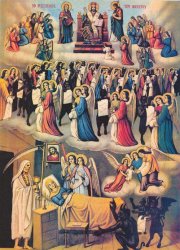
  • From the Orthodox Liturgical Tradition on the Encounter with Aerial Demons at the Time of Death

    For the sake of aiding discussions on the matter of the Toll Houses and Orthodox views on eschatology in general, I offer some excerpts from our liturgical tradition.   There are more, but these are just a few I selected arbitrarily:

    The Taxing of Souls at Death
    The Taxing of Souls at Death

    “Noetic roaring lions have surrounded me, seeking to carry me away and bitterly torment me. Do thou crush their teeth and jaws, O pure One, and save me” (Ode 3, Troparion 2).

    “Behold, terror has come to meet me, O Sovereign Lady, and I am afraid of it. Behold, a great struggle awaits me, in which be thou unto me a helper, O Hope of my salvation” (Ode 4, “Both Now”).

    “They that shall lead me hence have come, holding me on every side. But my soul shrinks back and is afraid, full of great rebelliousness, which do thou comfort, O pure One, by thine appearance” (Ode 7, “Glory”).

    “O thou that gavest birth to the Lord Almighty, when I come to die, do thou banish from me the commander of the bitter toll-gatherers and ruler of the earth, that I may glorify thee unto the ages, O holy Theotokos” (Ode 8, Troparion 3).

    And from another canon at the departing of the soul from the body, for those who have suffered a long time, by St. Andrew of Crete:

    “Come all you that have gathered together, who have lived your lives in piety, and lament the soul bereft of the glory of God, for shameful demons are striving to enslave it” (Ode 1, Troparion 1).

    “Behold, a multitude of evil spirits are standing about, holding the handwriting of my sins, and they cry out exceedingly, shamelessly seeking my lowly soul” (Ode 1, “Glory”).

    “O Sovereign Lady! O Sovereign Lady! Have mercy now on my perplexed soul looking to thy protection only, and do not disdain me, O Good One, who am being given over to demons” (Ode 4, “Both now”).

    “Have mercy on me, O all-holy Angels of God Almighty, and deliver me from all the evil toll-collectors, for I have no good deeds to balance my evil deeds” (Ode 7, Troparion 2).

    Source: St. Tikhon’s edition of the Book of Needs (Volume III, pages 75 ff.).

  • On the Aerial Demons Encountered at Death (from the Evergetinos)

    Hypothesis X

    The soul, after its departure from the body, undergoes testing in the air by evil spirits which encounter it and attempt to impede its ascent.

    A. From the Life of St. Anthony the Great

    1. St. Anthony the Great was once preparing to eat at his normal time; according to custom, he stood to pray. It was then the ninth hour. But at that very moment he felt himself somehow carried off spiritually. And this unusual thing took place: While he was standing there, he looked on himself, as though he had left his body, and his soul was taken into the air by several beings. After this, he saw a number of fearful and ugly creatures standing in front of him in the air, trying to keep him from passing.

    Those who were guiding his soul began to wrangle with these frightening creatures, who were asking for an account of the soul which they were accompanying and whether it was responsible to them for some debt. While the latter wanted to begin their assessment from St. Anthony’s birth, those who were accompanying him stopped them, saying: “Whatever errors Anthony committed from his birth have been erased away by the Lord; however, all of his deeds from the time that he became a monk and dedicated himself to God you may examine.”

    Though the demons accused Anthony, they could not prove their accusations; so his path remained free of impediments. Immediately, he saw himself return to his body, and he revived. And St. Anthony became as he had earlier been.

    However, such was his agitation that he forgot to eat, and he passed the rest of the day and the whole night groaning and praying.

    He was stunned when he reflected on how many temptations we must combat and what trials one must endure to pass by the air-borne demons. And he thought that this must be the meaning of the words of the Apostle Paul: “According to the prince of the power of the air” (Ephesians 2:2).

    For this power alone belongs to the Enemy of our souls, that is, to war against us and try to impede those souls ascending into Heaven. Thus St. Paul counsels us with even greater insistence, saying: “Take unto yourself the whole armor of God so that you can withstand the Devil on that wicked day, that the enemy might be brought to shame and thus have to say of you nothing dishonorable” (c.f. Ephesians 6:13).

    2. After this vision, several people went to visit St. Anthony and began to discuss with him the soul and where it goes after its departure from the body. The very next night, he heard a voice call to him saying:

    “Anthony, arise. Come out from your cell and look.”

    Indeed, St. Anthony the Great went out (for he knew what voices he should heed) and, having lifted his gaze up to Heaven, saw the following vision.

    A tall and fearful creature, horrible in form, was standing straight up. His height seemed to reach up to the clouds, while a multitude of creatures flew around him, as though they had wings. He would stretch out his hand and some of these he prevented from flying, while others succeeded in passing by and flying higher, continuing on their path without obstruction. This immensely tall demon would grit his teeth over those who escaped him; but, on the contrary, he would rejoice over those who drew near and were knocked down.

    Forthwith St. Anthony heard a voice:

    “Anthony, try to digest all that you have seen.” And thereupon he cleared his mind and reflected on what he had seen. It was the passage of souls into Heaven, and the immensely tall and frightening wild man, who was standing erect, was the Devil, who despises the faithful. He takes hold of those who have been guilty of sins and tries to prevent them from passing. Those who did not in their lives heed his counsel, however, he cannot hold, and for this reason such persons succeed in soaring above him and making their way to Heaven. When St. Anthony the Great saw this vision, it reminded him of the earlier one that he had seen, and he struggled daily, thereafter, to excel in the virtuous life.

    B. From the Gerontikon

    Two brothers once agreed both to become monks. After their tonsures, they rightly decided to build two cells, one some distance from the other. They departed from one another, therefore, and each was, for the sake of silence, cloistered in his cell. A number of years passed without one seeing the other, since neither of the two went out of his cell.

    It happened, however, that one of the brothers fell ill and the Fathers went to visit him. They observed that the monk fell into ecstasy and, a bit later, came to. So, with some curiosity, they asked him: “What did you see, Father.” “The Angels of God,” the sick monk answered, “coming to fetch me and my brother and to lead us into Heaven. As we were going up, we were met by hostile powers, countless in number and of fearful form. Though they bothered us a great deal, they nonetheless had no success against us. Just as we were passing by these powers of Satan, they started saying: ‘Purity gives great boldness to a soul!’”

    No sooner had he spoken these words than the monk reposed. When the Fathers who were there determined that he was dead, they sent a monk to announce this to his brother. But the monk found the brother also dead. And so the Fathers glorified God in wonderment.

    C. From St. Isaiah

    Beloved Brother: Those who occupy themselves with the ephemeral and vain world, if they advance and make gains, do not count the trials which they have endured, but rejoice at the progress which they have made. Can you imagine, then, my brother, what joy the soul of a man who undertakes spiritual work for God, and finishes it successfully experiences? It is natural for the soul to feel unfading joy for at the moment of its departure, the good works which it has done will precede it when it ascends into Heaven. At that time the Angels of God will rejoice together with it, as they see it delivered from the powers of darkness.

    This happens because, when the soul of man departs from the body the Angels go along with it. However, all of the powers of darkness then hasten to meet it and seek to take hold of it, thereby to examine it carefully and learn whether or not it was engaged i.e. any of their own works. It is not now the Angels who struggle with the demons to protect the soul; but the deeds of the soul surround and defend it, so that the demons cannot touch it. And if the good deeds of the soul defeat the demons, then the holy Angels sing on its behalf, until the soul, with joy and gladness, meets God. At that time, the soul completely forgets all of its good deeds in this vain world, as well as the labors it knew.

    Blessed, indeed, is he against whom the leaders of darkness can find nothing. He will find joy, honor, and rest beyond all measure. Let us thus weep with the whole power of our soul before God, that in His goodness He will take pity on us and send aid from on high, by which we might do all to conquer the leaders of evil, who obstruct our path [towards Paradise-Trans.]. Let us thus, disengaged from the many other pursuits of life, take care with resoluteness of heart to fulfill the Will of God, which will save us from the hands of the demons when they shall come to meet us there above.

    Let us remember love for the poor, that this love might save us from greed, when the sin of greed shall come to meet us.

    Let us acquire peace with all, the humble and the great, that this might guard us against hate, when it shall come to meet us.

    Let us acquire patience before all and in all things, that this might guard us against carelessness, when it shall come to meet us. Let us love all of our brothers and sisters, without hating anyone or repaying anyone any ill done against us; for this shall guard us against envy, when this demon too shall come to meet us.

    Let us love the endurance in humility of our neighbor’s word, even if this word should bring upon us hurt and derision; for humility will guard us against pride, when it too shall come to meet us.

    Let us seek to honor our neighbor and not to condemn or hurt anyone; for this shall protect us from gossip, when it shall come to meet us.

    Let us despise the cares of the world and its honors, that we might be saved from its bewitching evil, when it shall come to meet us.

    Let us teach our tongues to be unceasingly occupied with the commandments of God, righteousness, and prayer, that we might be protected from falsehood, when it too shall come to meet us.

    All of these foregoing evils impede the soul, while the virtues to which we have attained help it to confront these evils successfully. Now, what prudent man would commit his soul to eternal death, just to be relieved from the labors required to gain these virtues?

    Let us do all that is within our power and the power of our Lord Christ, which is great, to help humble ourselves; for our Lord Jesus Christ knows that man is hapless, and thus He has granted him repentance, as long as the soul is in this corruptible body, that he might, until his very last breath, correct himself and flee from sin.

    D. From the Gerontikon

    The esteemed Archbishop Theophilos said: Indeed what fear and terror and what need the soul experiences when it departs from the body or, afterwards, when it has been completely separated from it. For then all of the principalities and powers of darkness come upon it and make manifest all of the sins which it has committed, whether in knowledge or ignorance, from the time of a man’s birth until his last hours, when the soul is separated from the body. These powers brazenly draw near it and furiously accuse it.

    Confronting these hostile powers of darkness are the holy powers—Angels—putting forth and calling attention to the good deeds that soul occasioned to perform.

    Think what agony and terror the soul will experience when it stands before such a tribunal and faces such a fearful and impartial judgment.

    It is impossible for anyone to express in words or to conceive in his mind the fear that overtakes the soul up to the moment that the decision of the Judge is given, and it is released from those who hold it. That moment precisely is the moment of the soul’s greatest torment, until it hears the verdict of the Righteous judge.

    If, then, by the verdict of the Righteous Judge, the soul is given its freedom, immediately the enemies scatter and the bright Angels seize the soul from them and, with no more obstructions, it is led by the Angels to that inexpressible joy and glory to which it will finally be restored.

    If, however, the soul lived in carelessness, and is thus found unworthy of being freed, then it shall hear that most dreadful voice: “Let the ungodly be taken away that he see not the glory of the Lord”  (Isaiah 26:10).

    Henceforth begins for that soul the day of wrath, sorrow, and unceasing grief; it is given over to the outer darkness, hurled into Hell, and condemned to the eternal fire, in which it will remain damned unto the unfading ages.

    What, then, do the luxuries and fanfare of this world benefit the soul? Where are the vainglory and the delights and the enjoyments of this vain and fleeting world? Where is the money? Of what benefit a high birth? Where are your father, mother, brothers and sisters, and friends?

    What from all of this can free your wretched soul, as it is burned by the fire of Hell and tormented by indescribable punishment?

    Archbishop Chrysostomos, et al. The Evergetinos: A Complete Text. Book I. Etna, CA: Center for Traditionalist Orthodox Studies, 2008, pp. 85-89.

    Note: I believe that my posting of this brief excerpt falls under the fair use exception of copyright law. Please support the author and publisher by purchasing the book if you are edified by this except; the entire four volumes are simply wonderful.