Tag: Greenville
Information specific to our Greenville mission, Nativity of the Holy Theotokos Greek Orthodox Church.
-
Phone Calls That Never Lead to Visits

I’m at my secular job, focused on some computer-related task, and the phone rings.
“Father Anastasios?” asks the caller, somewhat unsure how to pronounce my name.
“Yes, how can I help you?”
“I have some questions about the Orthodox Church.”
This is how many conversations have begun in the past few years since I became a priest. I quickly move to a conference room, and then engage the caller, answering all his or her varied questions. They seem positive, and promise to come for services the next Sunday.
They don’t show up. And they never call again.
Unfortunately, many of the people who call us and ask about the Church show a momentary interest, but then fade away. I am reminded of the Parable of the Sower:
And it came to pass, as he sowed…some fell on stony ground, where it had not much earth; and immediately it sprang up, because it had no depth of earth: But when the sun was up, it was scorched; and because it had no root, it withered away (Mark 4:4-6).
Am I criticizing those who call and ask for information about the Church? Of course not! I love to talk to people, and answer questions about the Orthodox Church. I wouldn’t want someone who is genuinely interested in contacting me to hesitate to call. However, there is a difference between asking questions without making a commitment, and enthusiastically promising to visit and not showing up and not following up. Things come up; I know this, but why no follow-up phone call or email to let us know?
You see, I’m a caring person—it’s part of the reason I became a priest. I want to help people find the Truth, to find salvation in Jesus Christ, and the Church which He established. When people contact me and state an intention to come to the Church, I get excited and look forward with anticipation. When there is follow-through, I am pleased. When there is no visit, I feel disappointed. I pray for the people who contact me, and am genuinely concerned.
Such communications have taken a lot of my time and emotional energy; and my missions are growing, which means I am spending more time with those who have already joined the parish. Both of these are reasons why I have had to limit how much time I can spend speaking to new people on the telephone. Presently, I encourage people to visit the Church first, and I will answer their questions after the liturgy. Orthodox Christianity is best experienced; it is hard to understand it without visiting a liturgy and seeing it for oneself. Many questions can be answered just by participating in the Divine Liturgy.
No one who has questions about Orthodoxy should hesitate to contact us, for sure, and we look forward for your call, as you realize that Orthodox Christianity is the True Faith, and you seek to join us in the Church. It is a real blessing to us that there are many people who have called and emailed and have come to the Church, and are now members! You will not be the first to find Orthodoxy in this way, nor the last. So get your questions together, come to liturgy, and let’s talk!
-
Racially Segregated Churches
One thing I’ve noticed about Christian life here in North Carolina is that many, if not most, of the Protestant Churches in the area are still racially segregated. In contrast, most of the Roman Catholic Churches in the area are racially diverse (Masses in foreign languages do technically divide people up, but all are still members of the same parish).
It seems to me that the trend towards ever-more contemporary worship styles will probably continue to functionally keep people divided, because different ethnic and cultural groups in America tend to enjoy different styles of music and expressions of worship, in general. Those who advocate the use of contemporary worship music and practices often cite the generally unchurched nature of most young Americans, and contend that this approach gets seekers and inquirers into the Church while traditional Churches seem increasingly foreign to each succeeding generation. I do not wish to disparage the non-Orthodox people who are living their entire lives trying to preach Christ to those who know Him not; I count several such people as my friends, in fact. This article is not an evaluation of their methods, which I believe could find a way into a broad program of Orthodox missionary work, perhaps with some modifications (para-liturgical, of course). These Christians are mentioned here only to further the article’s main point.
The Orthodox liturgy, in contrast to contemporary worship, is worship that was established by the Apostles, and was passed down from them to each generation, through the succession of bishops that continues from the Apostles to our own bishops (a direct chain of ordination, all the way back). This liturgy, while having developed organically over the centuries, maintains the same structure as the earliest attested liturgies, and has changed little over the centuries. No committee or worship team ever sat down and decided how to “do” liturgy in the Orthodox Church.
Thinking in terms of an axis, there are both vertical and horizontal components to the unity of Orthodox worship; vertically, in the sense of time, having been passed down from the Apostles, and horizontally, in geographic terms, knowing that all Orthodox are worshipping in virtually the same way, whether in Uganda, America, or Greece. This unity is powerful. We fallen sinners enter in to this stream of worship, which has been going on since before we were born, and which will continue long after we are gone, which is bigger than any one of us.
Orthodox worship is timeless. It is never old-fashioned, or modern. It simply expresses a heavenly reality, a glimpse which the Holy Prophets, Apostles, and Fathers of the Church experienced and transmitted to us. Their divine visions gave much substance to the liturgy, which is also going on in Heaven continuously, as the Angels worship the Holy Trinity on the throne of glory. It is thus God-centered worship, and not created to appeal to the cultural whims of any given, short-lived generation.
Roman Catholics, having once been part of the Orthodox Church, and having a Mass which, while drastically emasculated by the “reforms” of 1969, is nonetheless still foundationally pattered on this same liturgical structure. Their insistence on there being one Church structure and one form of worship has allowed for a much greater integration. Thus, a visitor to a Roman Catholic Mass will notice people of all ethnicities together. This much better reflects the vision of the Holy Scriptures, where “There is neither Jew nor Greek, there is neither bond nor free, there is neither male nor female: for ye are all one in Christ Jesus” (Galatians 3:28).
Orthodox mission work in Eastern Carolina faces a challenge. A faith that was initially brought here by mostly Eastern European and Middle Eastern peoples, and which has expanded to include American converts initially mostly of Caucasian background, could easily fail to substantially reach all segments of the community. But this would be a failure, for all people deserve the chance to receive baptism for the remission of sins in the True Church of Christ, the Orthodox Church, the only Church with an unbroken link back to the Apostles and unchanged doctrine. Therefore, we are constantly evaluating our mission strategy, and looking for ways to invite people of all backgrounds in our Church. We desire to be a multi-racial, multi-ethnic community. In Greenville, we have already achieved an atmosphere that is welcoming to visitors of all backgrounds, and we seek to continue to develop this.
The Divine Liturgy is thus the catholic, or universal, form of worship for Christians. Orthodox hymnography is full of expressions such as that when Christ was raised on the Cross, He lifted “all men” to Himself, not just for instance His fellow Jews. It brings people of all backgrounds together. It does not, however, force us to abandon who we are, racially and culturally speaking. Thus, we can imagine that from that unified assembly, members would continue to express their Orthodox faith in ways comfortable to their own background, and in their own neighborhoods. The universal will thus bring fulfillment to the particular.
If you believe that Churches should be places where all people worship together, and not a religious reaffirmation of long-standing ethnic divisions in the community, then contact us and learn how to become part of our work, to further the Gospel and Church of Our Lord Jesus Christ.
-
Mapping Out a Mission Plan
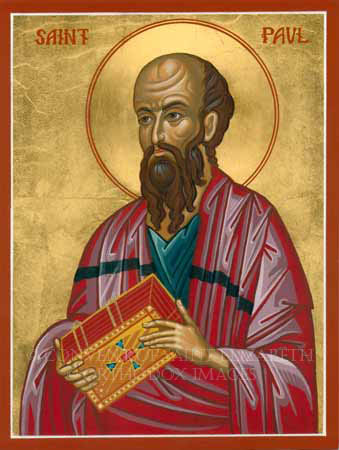
Saint Paul the Apostle, the Greatest Missionary When it comes to missionary work, is there a certain tension between trusting in God’s providence (Luke 10:4), and planning ahead (cf. Acts 15:36, 20:13)? If there is, it can only be attributed to our fallen human nature, where our own will is constantly trying to supplant God’s; among those who have grown in holiness, this tension is disappearing or has disappeared completely, as the case may be. Practically speaking, when we look at the example of the greatest missionary, St. Paul the Apostle, he carefully planned his journeys and work, but was always open to changing them if God called him to do so (Acts 16:7-8).
In this spirit, we offer our current mission plan, which we have developed through our experience in planting missions in North Carolina from 2006 to the present. Should we understand as time progresses that God wills that part or all of our plan should be altered, we will resolve to do so. But being open to God’s will does not negate the necessity of planning, preparing, and sharing our vision, especially because by so doing, we are already alerting others to what is occurring and inviting them to join us in our work, and opening ourselves up to feedback and constructive criticism from the bretheren, which will refine our objectives and methods.
Our primary objective must be clearly stated: we seek to bring those who do not know Jesus Christ to faith in Him, for Christ Himself says: “I am the way, the truth, and the life: no man cometh unto the Father, but by me” (John 14:6). We must be careful, at the same time, to not assume that just because someone professes faith in Christ or even attends a Church, that he or she has made Christ the Lord and Master of his life, has submitted himself or herself unconditionally to Christ, or has the tools and knowledge of Christ—the context, as it were—to grow as a Christian. As Orthodox Christians, we further understand that when St. Paul confesses that the Church is the “pillar and ground (foundation) of the truth” (I Timothy 3:15), that this refers to a visible Church, with real teaching authority, which has existed from the time of the Apostles to today. This is at variance with what the majority of Christians in Eastern Carolina believe, and so we must tread carefully, and oftentimes recognize that a different approach may be required with different people, never assuming anything.
Orthodox Churches require priests, an ordained office, to conduct baptisms, weddings, funerals, and the Divine Liturgy—the communion service of the Orthodox Church. This makes mission work different from many Protestant models. At the same time, unlike the clericalist model which dominated much of Roman Catholic thought and practice for the past millennium (but which is thankfully abating to some extent), laypeople have always had a central position in the maintaining of and prorogation of the faith, and responsible non-clergy can be appointed to lead prayers among laypeople. Our work then is a synergy of the various offices that Christ established: “And he gave some, apostles; and some, prophets; and some, evangelists; and some, pastors and teachers” (Ephesians 4:11).
In our present time, there is a shortage of priests. In reality, there has always been a shortage of workers. As it is stated in Scripture: “The harvest truly is great, but the labourers are few: pray ye therefore the Lord of the harvest, that he would send forth labourers into his harvest” (Luke 10:2). We find in our work that adult converts are often the most fervent Christians, and therefore we have confidence that among the great harvest are found laborers, who can be added to our work through prayer. We never know when that email or phone call will come, where a new person is volunteering to help, yet they do come unexpectedly, when our need is greatest, and give us encouragement.

Worshipers at Orthodox Church in Greenville, NC on Pascha (Easter) 2011 We will now turn to our present situation in Eastern Carolina. We have one priest who serves both Raleigh and Greenville, Fr. Anastasios Hudson, who travels back and forth, offering three liturgies in Greenville each month and two to three in Raleigh. Members come from all over Eastern Carolina to attend services in the Greenville mission: from Greenville proper, and from New Bern, Belhaven, Beaufort County, and other neighboring locales. We pray that as the Orthodox Church in Greenville, NC grows, two things will happen. First, we pray that God will raise up a local man (or men) to serve as priests there. As St. Paul established missions, he selected able men to take the leadership of the communities, while not completely leaving them to their own devices—he maintained a fatherly oversight. So we envision that Fr. Anastasios’s work in Greenville would include helping the bishop identify a candidate for ordination, training the candidate, and then giving him mentorship for several years as he would take on more and more responsibility, until he finally would be autonomous, but never separate from the other clergy working in the area.
The second thing we would pray to see is areas where there are more than one family residing who are commuting to Greenville. For instance, perhaps in the future there will be three families coming from Wilson, or two families from Rocky Mount. Especially in cases with multiple children, commuting every week might be difficult, and in addition, it is harder to invite one’s family, friends, and neighbors to a Church that is far away. We would bless these families to meet together in their own towns on the weekends they do not make it to Greenville’s Church, to pray together and invite others to learn about Orthodox Christianity. This might be somewhat akin to what some Protestant churches do with “small groups.” As these local groups grow, and as priestly availability permits, liturgies and talks could be scheduled in these communities, leading them to become missions of their own. As they grow, they could then become the bases for further, future expansion, thus repeating the process.
Dare we hope for a time, in our lifetime, when Eastern North Carolina is dotted with Orthodox Churches and missions? We would say yes! Since we established the parish in Greenville, we have witnessed how Orthodox faith in Christ Jesus changes lives and draws people together, renewing and strengthening the bonds between men. Families have already dedicated themselves fully to this work, and we believe that as more are exposed to the faith, they will join us in our effort, and as more join us in our effort, more will encounter the Church of Christ.
-
Christ Is Risen!
We’d like to wish all residents of Eastern North Carolina a blessed Pascha (Easter) with the traditional Orthodox greeting, “Christ is Risen!” The response is, “Truly He is Risen!” This greeting will be used from now until Ascension Thursday, which is the 40th day after Pascha.
At the Easter service in Greenville at Holy Theotokos Church this year, we had a record number of attendees. Some people drove from 30, 60, and even 90 miles away to celebrate with us. One gentleman came from Rocky Mount, which gives us hope that one day there will be an Orthodox Church in that town established to glorify God and bring souls to Christ through His Church. Are you in Rocky Mount and interested in exploring the Orthodox Church? Contact us!
-
How We Founded an Orthodox Church in Greenville, NC

The interior of the current location of Nativity of the Holy Theotokos Greek Orthodox Church in Greenville, NC Nativity of the Holy Theotokos Greek Orthodox Church in Greenville, North Carolina held its first services on Saturday, September 7/20, 2008: Vespers for our patronal feastday, the birthday of the Virgin Mary. But how did it all come together?
Back in March of 2008, the Tourlitis family found Anastasios Hudson via the Metropolis of America’s website. Anastasios and his wife were the founders of an Orthodox Christian Mission in Raleigh, which at that time did not have a regular priest. Reader’s services were being held weekly for a small group of faithful. The Tourlitis and Hudson families met in Wilson, North Carolina at a restaurant one Saturday in order to talk about the possibility of founding a similar mission in Greenville.

Fr. Anastasios Hudson Ordained, June 2008 The meeting really was a meeting of the minds; both families were completely on the same page and that was evident from day one. Anastasios spoke with Metropolitan Pavlos, the diocesan bishop, about the situation, and he decided to ordain Anastasios a priest in order to serve both missions. On Pascha, April 13/26, 2008, Anastasios was made a deacon, and on the Sunday of All Saints, June 9/22, 2008, Deacon Anastasios was made a priest. The Tourlitis family was able to attend the priestly ordination and receive the blessing of His Eminence in order to proceed.

Fellowship After First Liturgy, September 2008 A great boon to the project occurred that very same week, when a property on Avon Road became available for use by the new Church. Tony Tourlitis transformed the existing home into a Church over the next two months, a labor of great love. On July 20/August 2, 2008, Fr. Anastasios performed an agiasmo (water blessing) on the new property, and thus by September 7/20, services were ready to begin. At this service, another local family, not even Orthodox, were invited to attend, and became regular members of the parish.
Such is missions work; two dedicated families came together following the call of God, and were able to accomplish so much in a few short months. Three years later, the mission has grown, moved to a new, larger location, and continued to witness the Gospel of Our Lord Jesus Christ to the people of Greenville and surrounding areas.
We welcome you to join us in our work; whether you live in Greenville or another area of Eastern Carolina, we would love to hear from you.
-
Orthodox Mission Work in Eastern Carolina
Our first mission plant in the region is Nativity of the Holy Theotokos, a Greek Orthodox Church in Greenville, North Carolina. Currently, the mission is growing steadily and we hope to attain full parish status in a few years. Members and regular visitors come from all over Eastern Carolina to attend worship: Greenville, Blounts Creek, Washington, New Bern, Kinston, Belhaven, etc. Some drive 70 miles each way every week in order to participate!
We hope that just as Nativity of the Holy Theotokos was planted with help from members of St. Mark the Evangelist Orthodox Church in Raleigh, our parish will one day soon be able to branch out through its diverse members and plant missions in other areas of Eastern Carolina in order to further the Gospel of Our Lord Jesus Christ, and spread knowledge of His Holy Church, the Orthodox Christian Church.
We are painfully aware of the lack of an Orthodox Christian presence in Rocky Mount, Wilson, Goldsboro, and other parts of our state. While we are small, God has already accomplished so much through us; we have faith that as interested parties arise in these other areas, they will be called to join us in our work, initially making the sacrifice of driving to Greenville as often as possible, and then one day working with us to open a mission in their area.


